The article Wood instead of lithium: Sodium-ion battery from the Thuringian Forest first appeared in the online magazine BASIC thinking. With our newsletter UPDATE you can start the day well informed every morning.
In order to advance the energy transition, cost-effective, safe and resource-saving energy storage systems are required. A new idea comes from the Thuringian Forest: sustainable batteries made from wood waste. The backgrounds.
The future of sustainable battery production apparently comes from the heart of Germany: In the Thuringian Forest, researchers are working on producing so-called sodium-ion batteries based almost entirely on local and renewable raw materials.
The project called “ThüNaBsE” (Thuringian sodium-ion battery for scalable energy storage) is a collaboration between the Fraunhofer Institute IKTS and the Friedrich Schiller University Jena.
This is how the sodium-ion battery from the Thuringian Forest works
The focus of the research is the material lignin. It is produced in large quantities as a by-product in the wood and pulp industry. As a biopolymer, the material gives the wood its strength.
Until now, lignin was usually burned to generate energy. However, scientists have now found another useful use.
Lignin consists mainly of hydrocarbon building blocks that can be usefully used in chemistry, for example as electrode material for batteries. In the project, the bio-based raw material will be used for the negative electrode.
To do this, the lignin is refined into hard carbon in a thermal process with the exclusion of heat and air. This porous, stable carbon structure can reversibly store sodium ions. Non-toxic iron compounds, so-called Prussian blue analogues, are used as the material for the positive electrode.
Independence thanks to local raw materials
The sustainable sodium-ion battery is intended to make an important contribution to strengthening independence from critical raw materials and to the shift towards cheaper, more sustainable and safe batteries, it says Press release.
“We want to avoid using critical metals such as lithium, cobalt and nickel in batteries in the value chain,” explains Dr. Lukas Medenbach, scientist at Fraunhofer IKTS in Arnstadt.
We would also like to keep the fluorine content in electrodes and electrolyte as low as possible and test to what extent it can be completely avoided. The core of the project is the processing of locally available, high-quality lignin into powerful electrodes in our sodium-ion batteries.
Another goal of the project is to promote young researchers in Thuringia. Therefore, a number of young scientists are involved in “ThüNaBsE” who are doing their doctorates in the fields of energy and battery research.
Initial tests promising
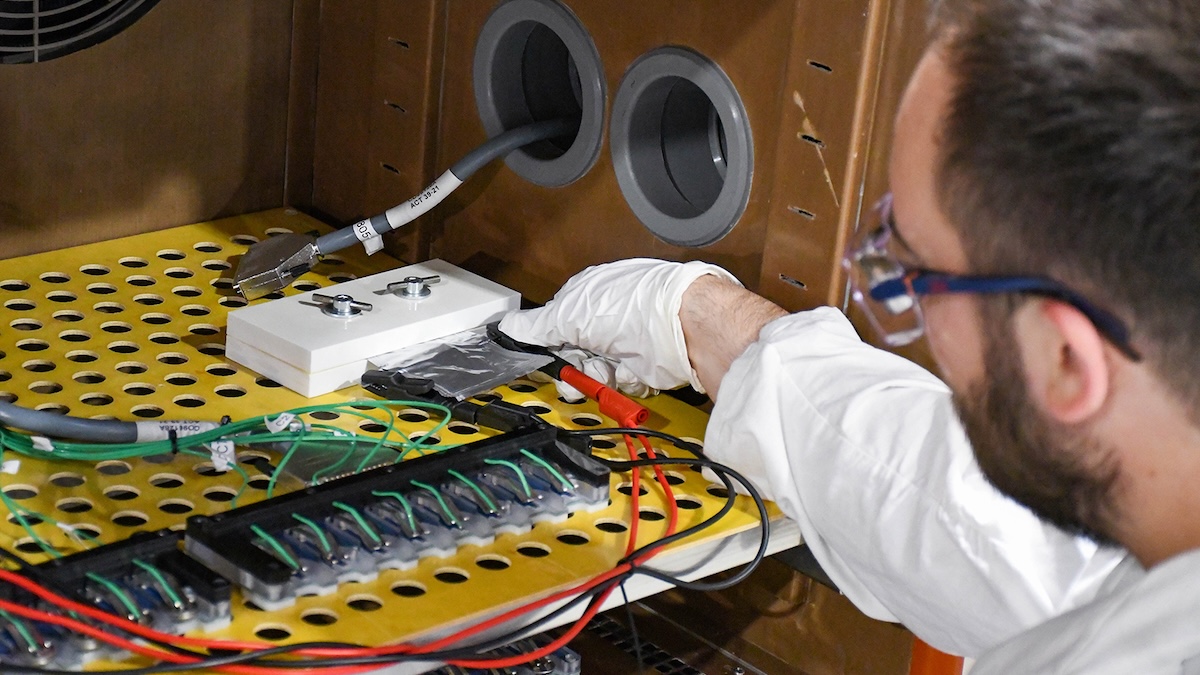
The first small demonstrator cells are currently being built and tested in battery test centers in Arnstadt, Hermsdorf and Jena. The laboratory work is accompanied by realistic, multi-physical simulations.
The results are promising: “The laboratory cell has not yet degraded significantly after 100 charging and discharging cycles. The goal is to demonstrate 200 charging and discharging cycles for a full hour amp cell at the end of the project,” says Medenbach.
This is how the sustainable forest batteries are to be used
The fully developed battery could be used as stationary or mobile storage where fast charging times are not required. For example, lignin-based sodium-ion batteries are suitable for mobile applications with lower power requirements.
Microcars or industrial trucks such as forklifts are possible. After the research phase has been completed, the plan is to further scale the technology and move towards market readiness in an even larger consortium.
The project is funded by the Free State of Thuringia and the European Social Fund and is supported by a strong, predominantly regional industrial advisory board.
Also interesting:
- Researchers develop flexible lithium-ion battery
- Huge heat battery: Heineken wants to brew beer with solar energy
- The myth of the heating law: abolishing it would harm Germany
- New quantum battery stores energy without loss of charge
The article Wood instead of lithium: Sodium-ion battery from the Thuringian Forest appeared first on BASIC thinking. Follow us too Google News and Flipboard or subscribe to our newsletter UPDATE.
As a tech industry expert, I find the idea of using wood instead of lithium in sodium-ion batteries to be a fascinating concept with potential benefits. Wood is a renewable and abundant resource, making it a more sustainable option compared to lithium which has limited availability and environmental concerns in its extraction.
The use of wood from the Thuringian Forest specifically adds an interesting local and regional aspect to the battery production process. It could potentially create economic opportunities for the region and promote the use of locally sourced materials in technology manufacturing.
However, there are also challenges and considerations to be addressed in utilizing wood for battery production. The process of converting wood into a usable form for battery components may require significant resources and energy, potentially offsetting some of the sustainability benefits. Additionally, the performance and efficiency of wood-based sodium-ion batteries would need to be thoroughly tested and optimized to ensure they can compete with traditional lithium batteries in terms of power and longevity.
Overall, the concept of using wood from the Thuringian Forest in sodium-ion batteries presents an intriguing opportunity for innovation and sustainability in the tech industry. It will be interesting to see how this technology develops and if it can become a viable alternative to lithium batteries in the future.
Credits