The article New heat pump turns rivers and lakes into heating appeared first in the online magazine BASIC thinking. With our newsletter UPDATE you can start the day well informed every morning.
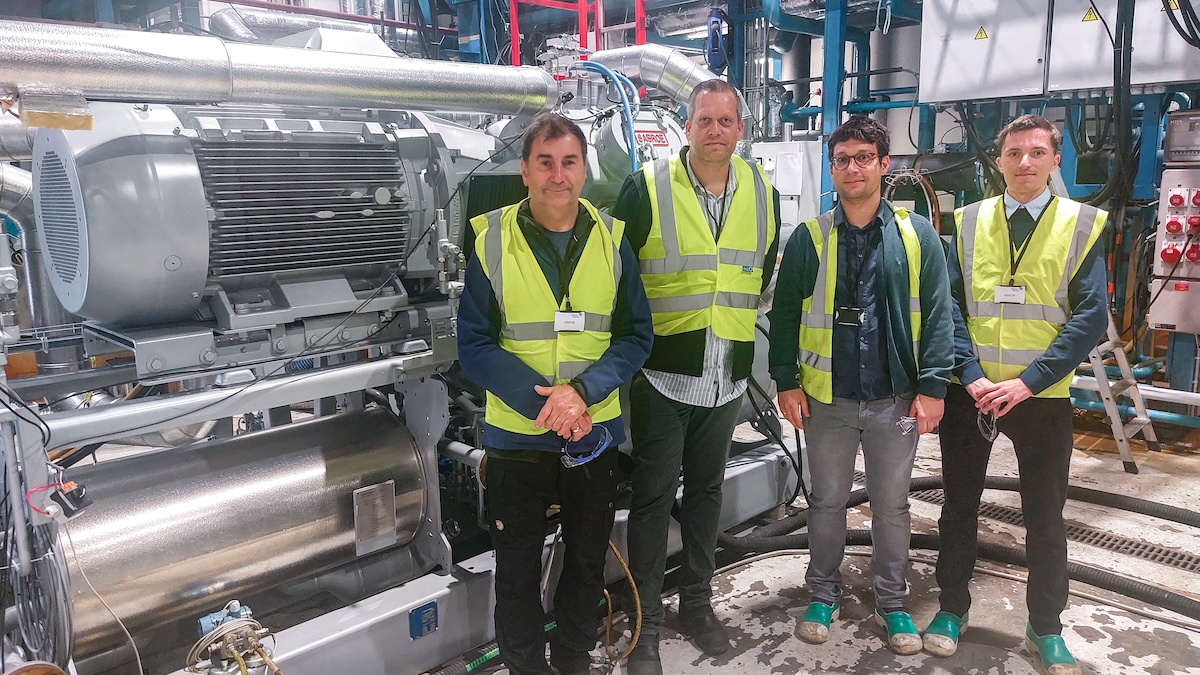
With a new type of heat pump, researchers want to use rivers and lakes in Germany as heating in the future. It is said to provide thermal energy even at temperatures around freezing point.
Year-round heat from regional waters: An obvious idea when you consider the large number of lakes and rivers in Germany. Using them as a heat source is possible thanks to the concept of aquathermy. Heat is extracted from water and brought to the required heating or cooling temperature using a heat pump.
Despite its considerable potential, the approach has so far only been used to a limited extent. In addition to regulatory hurdles, this also has to do with technical challenges. In this country, for example, seasonal temperature fluctuations and the infrastructure are a problem. Researchers from Saxony now want to change that.
Heat pump from Saxony heats lakes and rivers
For the project AQVA HEAT III Scientists from Zittau/Görlitz University, Fraunhofer IEG and the Institute for Air and Refrigeration Technology in Dresden joined forces to investigate the year-round heat supply through the thermal use of surface water.
To achieve this, the project team has developed an integrated system that uses water as a heat source. What’s special: The system works in two main stages and is specially optimized for the use of cold water.
Heat even at zero degrees Celsius
In the first stage, a so-called vacuum liquid ice maker (VFE) is used. The element water is used directly as a refrigerant. Among other things, this has the advantage that it occurs naturally and is non-toxic.
By direct evaporation of river or lake water under vacuum, the system can extract heat even at water temperatures down to zero degrees Celsius. This process leads to the formation of liquid ice and ensures that the heat pump can operate efficiently even in the depths of winter.
Another advantage of using water as a refrigerant is its high energy density. It makes it possible to develop smaller bodies of water than would be possible with conventional systems.
According to Fraunhofer IEG, the resulting temperature after the VFE is constantly at least 12 degrees Celsius. A classic two-stage heat pump raises the temperature level in the second stage to up to 90 degrees Celsius in order to feed the heat into the district heating network of Stadtwerke Zittau.
This is how the energy comes into the local heating network
A challenge when designing the project was dealing with the enormous temperature swing from 12 degrees Celsius to 90 degrees Celsius. The research team also had to comply with comprehensive safety and fire protection requirements, as the heat pump will be installed in a hall belonging to the Zittau municipal utility company.
An essential part of the project is also the investigation of the aquatic ecological consequences. The research team is simulatively and experimentally analyzing various methods of water extraction and return to ensure that the thermal use of water has no negative impact on the ecosystem.
The project team has now reached a first milestone: the factory acceptance of the heat pump took place in Aarhus at the beginning of November 2025.
This form of heat source development offers potential for planning, security of supply and grid integration and can be scaled from around 100 kW (thermal) to megawatt levels, whereby the amount of river water used and the amount of electricity used remain comparatively small.
The project team wants to carry out the subsequent integration into the overall system in the first half of 2026, according to Fraunhofer IEG. The entire system will then be subject to seasonal testing for a year.
Also interesting:
- Europe: The countries with the most heat pumps
- Despite their mega potential, large industrial heat pumps have a niche existence
- Low-temperature fuel cell boosts hydrogen energy
- New quantum battery stores energy without loss of charge
The post New heat pump turns rivers and lakes into heating appeared first on BASIC thinking. Follow us too Google News and Flipboard or subscribe to our newsletter UPDATE.
As a Tech Industry expert, I find the concept of using innovative heat pump technology to heat rivers and lakes to be a fascinating and potentially groundbreaking development. By utilizing heat pumps to extract and transfer heat from natural bodies of water, we can not only help to regulate water temperatures for environmental and ecological purposes, but also harness that heat energy for various applications.
This technology could have numerous practical applications, such as providing heating for nearby buildings or infrastructure, generating renewable energy, or even aiding in the cultivation of aquatic life in aquaculture systems. Additionally, by using heat pumps to heat rivers and lakes, we can potentially reduce the reliance on traditional heating methods that contribute to carbon emissions and environmental degradation.
Overall, I believe that the use of innovative heat pump technology to heat rivers and lakes has the potential to revolutionize how we interact with and utilize our natural resources in a more sustainable and efficient manner. It will be interesting to see how this technology develops and is implemented in the future.
Credits