The article Chemistry trick makes bromine flow batteries significantly more efficient first appeared in the online magazine BASIC thinking. With our newsletter UPDATE you can start the day well informed every morning.
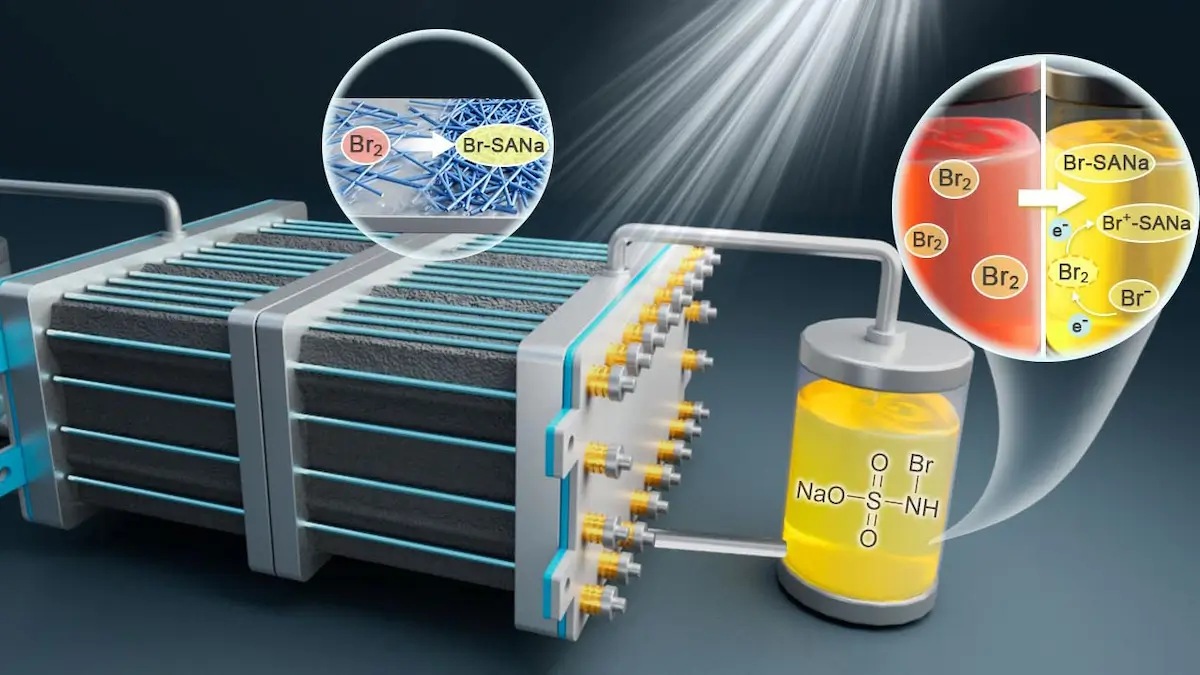
A new chemical trick could make bromine flow batteries significantly longer lasting and cheaper. Researchers have added the aggressive bromine to enable higher cycles and higher energy density.
Bromine-based flow batteries could play a crucial role in storing renewable energy as they are based on widely available raw materials and promise high energy density. However, traditional systems produce elemental bromine during the charging process, which can cause severe corrosion damage to the battery’s internal components.
In addition, previous additives often lead to an undesirable separation of the electrolytes into different phases, which reduces efficiency. A research team led by Xianfeng Li now has a new chemical approach developedto solve this problem.
By adding organic amine compounds to the electrolyte, they act as bromine scavengers and convert the resulting bromine into stable brominated amines. This process reduces the concentration of free bromine in the electrolyte to a relatively low level.
Bromine flow batteries: Multi-electron transfer increases efficiency
The technological innovation enables two-electron transfer, whereas standard reactions were previously only able to transfer a single electron. This change not only increases the energy density of the battery, but also reduces corrosive behavior inside the system.
This significantly extends the service life of the storage solutions, making bromine flow batteries more attractive for large-scale use. In practical tests with a scaled five kilowatt system, the battery was able to operate stably over 700 charge and discharge cycles.
According to the researchers, due to the low concentration of bromine, it is possible to use inexpensive, non-fluorinated membranes instead of expensive special components. After the tests were completed, there appeared to be no corrosion damage to important components such as electrodes or current collectors.
Future of grid storage
The researchers see their approach as the foundation for long-lasting and safe zinc-bromine flow batteries on an industrial scale. The technology offers a path to a sustainable energy infrastructure that is both efficient and economically viable.
Especially in times when storing energy in batteries is more important than ever, the technology could support a transition to sustainable energy sources.
Also interesting:
- What are AI agents? Definition and examples of new technology
- Google Gemini: What you need to know about the new AI
- ChatGPT Plus: The subscription model offers these functions
- Electric car: What happens if the battery runs out in a traffic jam?
The post Chemistry trick makes bromine flow batteries significantly more efficient appeared first on BASIC thinking. Follow us too Google News and Flipboard or subscribe to our newsletter UPDATE.
As a Tech Industry expert, I find the development of using a chemistry trick to make bromine flow batteries more efficient to be a promising advancement in energy storage technology. Bromine flow batteries have long been seen as a potential alternative to traditional lithium-ion batteries due to their lower cost and longer lifespan, but they have struggled with low efficiency levels.
By utilizing a chemistry trick to enhance the reaction kinetics within the battery, researchers have been able to significantly improve the efficiency of bromine flow batteries. This breakthrough has the potential to make these batteries more competitive with lithium-ion batteries in terms of energy storage capacity and overall performance.
Overall, I believe that this development is a positive step towards creating more sustainable and affordable energy storage solutions for the tech industry and beyond. I look forward to seeing how this technology continues to evolve and potentially revolutionize the way we store and utilize energy in the future.
Credits