The article Cheaper and more efficient: Battery storage overtakes gas power plants first appeared in the online magazine BASIC thinking. With our newsletter UPDATE you can start the day well informed every morning.
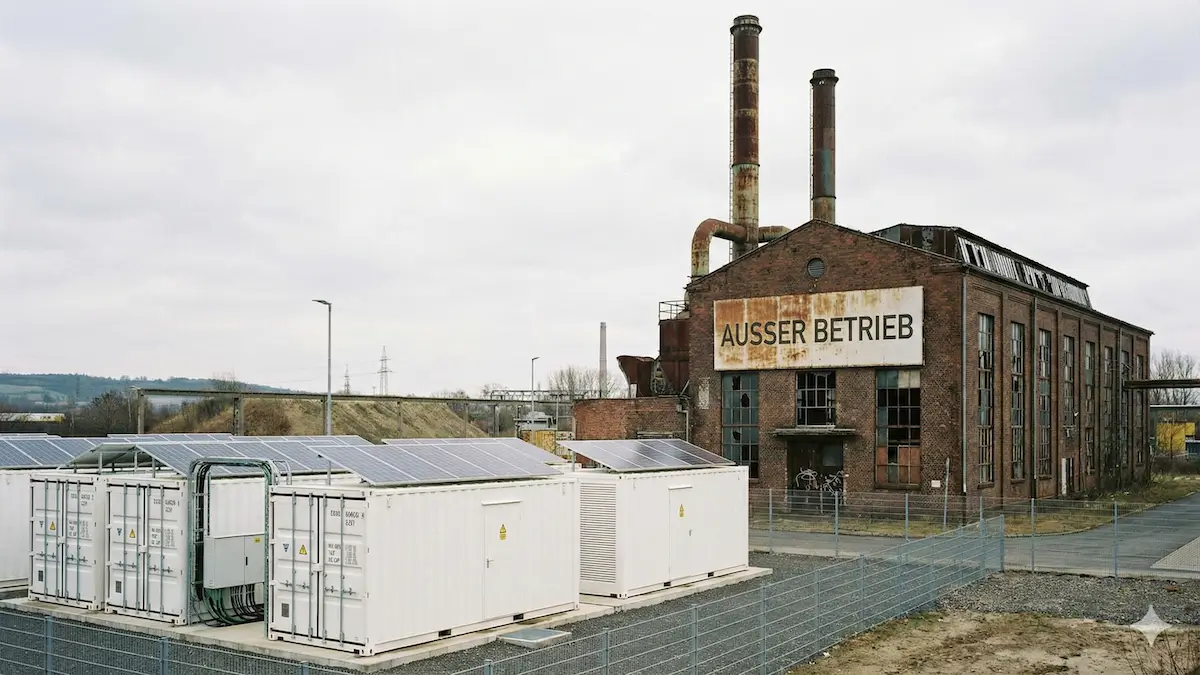
Large battery storage systems are increasingly displacing gas-fired power plants from the electricity market and are considered a key technology in the energy transition. Falling costs and technological advances make them a cheaper alternative, especially when combined with solar and wind power.
Large battery storage systems are increasingly displacing classic gas turbines from the power grid. According to data According to the private research institute Rystad Energy, the power available worldwide from large-scale battery storage systems now exceeds the capacity of all pumped storage power plants. In 2025 alone, an additional 100 gigawatts or 280 gigawatt hours were put into operation.
Falling prices for battery storage had a measurable impact on global gas consumption for the first time last year. While costs in the European Union fell by ten percent compared to the previous year, prices in China fell even more significantly. In the EU, the costs reached the equivalent of 180 euros per kilowatt hour in 2025. Rystad Energy predicts that this value will fall to 170 euros in 2026.
Storage solutions are therefore increasingly more economical, as the stored electricity only increases in price by around four cents. In a direct comparison, conventional gas power plants perform better, according to Fraunhofer Institute for Solar Energy Systems worse off. In the best case, these cause costs between just over seven and 15.4 cents per kilowatt hour.
Battery storage more economical than gas power plants
Rising carbon dioxide prices and lower utilization could even push these costs for gas to over 30 cents. Electricity from photovoltaics and wind power, on the other hand, is sometimes less than five cents.
Thanks to the combination of cheap generation and increasing battery capacities, operators are now taking advantage of overproduction at times when gas turbines previously stepped in. Rystad Energy first observed this phenomenon in the Australian state of Victoria and California. The institute expects a similar development in other regions of Australia and Europe in 2026.
Large-scale storage systems are no longer just used to smooth out production from renewable energies. In 2021, this phenomenon was practically non-existent, which is why surpluses were often lost unused. Operators in many regions are now already using intermediate storage as a cheaper alternative to providing gas turbines.
Outlook for global bridging
Nevertheless, the market report assumes that the annual expansion rate will weaken in the future. While this is currently almost 50 percent, it could fall to around 20 percent by 2030. The authors cite rising prices for lithium and changing economic conditions in China as reasons for this.
In the USA, on the other hand, prices per kilowatt hour have recently trended upwards, contrary to the global trend. Despite regional price differences, the trend towards expansion remains unbroken worldwide. The total electricity prices including storage sometimes remain below ten cents per kilowatt hour, provided there are enough inexpensive storage units available in the network.
However, global developments show that battery storage has established itself as the cheapest alternative to bridging. In many areas, the technology is already replacing the need to have gas turbines available for peak loads. The market for energy storage therefore remains a central component of modern energy supply.
Also interesting:
- Solar implant with AI should enable blind people to read again
- ChatGPT is listening: This is how you can deactivate background conversations
- Vertical wind turbine with AI – for houses in the city
- Electricity through steps: the future of sustainable energy?
The post Cheaper and more efficient: Battery storage overtakes gas power plants appeared first on BASIC thinking. Follow us too Google News and Flipboard or subscribe to our newsletter UPDATE.
As a Tech Industry expert, I believe that the shift towards cheaper and more efficient battery storage overtaking gas-fired power plants is a significant and positive development for the energy sector. Battery storage technology has advanced rapidly in recent years, making it a more viable and cost-effective option for storing energy generated from renewable sources such as solar and wind power.
Not only do batteries offer a more environmentally friendly alternative to gas-fired power plants, but they also provide greater flexibility and reliability in the delivery of energy. With the ability to store excess energy during times of low demand and release it when needed, batteries can help stabilize the grid and reduce the reliance on fossil fuels.
Furthermore, the decreasing cost of battery storage technology means that it is becoming increasingly competitive with traditional power plants. This trend is likely to accelerate as economies of scale and technological advancements drive down costs even further.
Overall, the shift towards cheaper and more efficient battery storage represents a positive step towards a more sustainable and resilient energy system. I believe that continued investment and innovation in battery technology will play a crucial role in driving the transition towards a cleaner and more efficient energy future.
Credits