The article Charging stations as multiple sockets: General Motors patent for new charging parks first appeared in the online magazine BASIC thinking. With our newsletter UPDATE you can start the day well informed every morning.
A new idea from General Motors could fundamentally change the way electric cars are charged: Instead of individual columns, a system distributes the power to several vehicles at the same time. This promises less waiting time and more efficient use of existing infrastructure.
Automobile manufacturer General Motors has one patent developed for a new type of charging infrastructure. It was submitted back in 2024 and published in February 2026. The approach distributes electricity like a multiple socket and is intended to increase the capacity of existing charging parks.
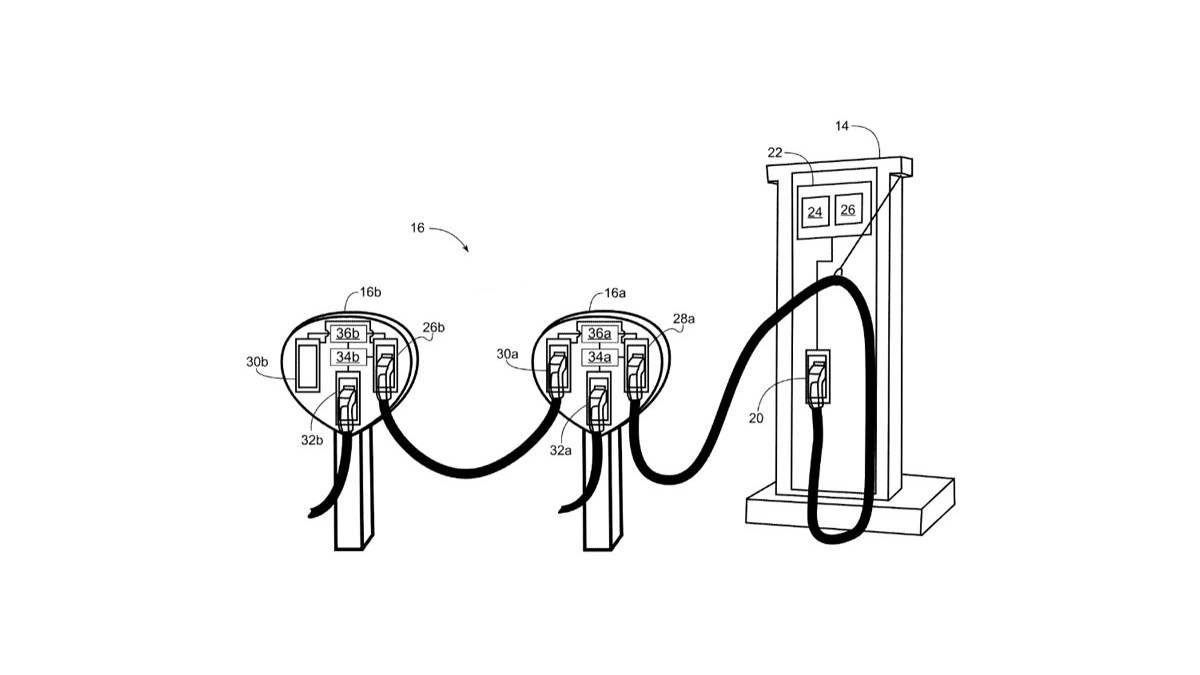
The main goal is to equalize congested locations through efficient energy distribution. Since charging parks often reach their limits despite growing infrastructure, the draft could offer a technical solution. In the concept, a central direct current (DC) fast charger distributes the available power across several modules.
These low-power access points (LPAP) serve as additional connections for the electric cars. Thanks to the modular structure, several vehicles charge at the same time at a single base station. The system specifically relies on DC fast charger technology and could eliminate bottlenecks on motorways.
Multiple socket for charging stations: This is how the new charging system from General Motors works
The networking between the main charger and the modules is based on a special series connection. Engineers refer to the method as daisy chain. An electric car docks onto each of these additional modules, ensuring that the hardware achieves optimal utilization. Instead of an isolated charging point, a network of multiple access points is created.
The special feature is the communication between the modules and the connected vehicles. The system continuously analyzes:
- Charging status of the vehicles
- Battery voltage and requirements
- Current utilization of all connected cars
Based on this data, the system decides in real time about the allocation of charging power. The energy should flow exactly where the need is highest.
Intelligent energy distribution instead of fixed charging power
The modules analyze the needs of all connected vehicles and dynamically adjust the power output. The system takes into account different battery technologies and vehicle voltage levels.
It controls energy flows to prevent overloads and optimize charging time. This intelligent process transforms a simple column into a connected hub.
In practice, this means that the overall performance available is no longer rigidly tied to a single user. A single vehicle no longer blocks the fast charger exclusively, as the control serves an entire group in parallel.
With this, GM wants to potentially process more charging processes in the same time than with conventional systems. The system processes vehicles as a team instead of sending them into a queue one after the other.
More efficiency in overloaded charging parks
For users, this technology promises a noticeable improvement in comfort when traveling. Multiple vehicles could join immediately as soon as they arrive at the location without waiting for a free point. Waiting in a queue would be eliminated due to the higher number of physical connections. The time at the charging park could be used much more efficiently.
The prioritization function would particularly help drivers with a very low battery level. In addition, the system could prefer an almost empty vehicle so that it can quickly obtain a basic range for further travel. Meanwhile, other cars with higher levels would continue to charge in parallel with reduced power. In the end, what counts for drivers is the actual time saved and not just the maximum charging performance on paper.
This is what electric car drivers say
A current survey of 2,341 participants shows how diverse the charging habits of electric car owners are. While some of those surveyed still rely on a household socket, many already use their own wallbox. Public charging stations also play a central role in drivers’ everyday lives. Interestingly, some participants stated that they did not yet own an electric car.
The principle of power distribution already exists in the industry for alternating current (AC) charging. An example is provided by the Munich company ChargeX, which distributes the energy of a connection in a modular manner. These solutions are primarily aimed at locations such as company parking lots or residential complexes with lower services. The focus there is on charging over longer periods of time with eleven or 22 kilowatts.
Will GM’s new charging concept become a reality?
General Motors’ patent, on the other hand, focuses on fast charging with significantly higher performance. According to the patent, the system starts where most bottlenecks arise today: at fast-charging parks along the highways.
A high energy output in a short time is crucial here in order to keep the traffic flow stable. A distribution of DC power therefore represents a logical further development for long-distance transport. To date, this development has only been available as a theoretical representation in a patent specification. Whether and when such a system will reach market maturity for series production remains completely open at the moment.
The actual benefits for future mobility depend on whether General Motors ever makes the system a reality. However, the trend is moving away from the search for the strongest individual column towards the intelligent distribution of the available power.
Also interesting:
- Simply explained: How does a wind turbine actually work?
- E20: What you need to know about the new organic fuel
- Pseudo-noise and infrasound: No evidence for wind turbine myths
- Battery technologies in comparison: lithium, sodium, solid state and redox flow
The post Charging stations as multiple sockets: General Motors patent for new charging parks appeared first on BASIC thinking. Follow us too Google News and Flipboard or subscribe to our newsletter UPDATE.
As a tech industry expert, I think General Motors’ patent for new charging parks with multiple sockets is a smart move in addressing the growing demand for electric vehicle charging infrastructure. By providing multiple sockets at these charging stations, GM is effectively increasing the capacity for more vehicles to charge simultaneously, reducing wait times and allowing for a more seamless charging experience for EV owners.
This innovation is particularly important as the adoption of electric vehicles continues to rise, and the need for reliable and efficient charging solutions becomes more pressing. By investing in charging parks with multiple sockets, GM is not only catering to the current needs of EV owners but also future-proofing their infrastructure for the expected growth in electric vehicle sales.
Furthermore, the patent for new charging parks with multiple sockets demonstrates GM’s commitment to sustainability and environmental stewardship. By encouraging the use of electric vehicles through improved charging infrastructure, GM is contributing to the reduction of greenhouse gas emissions and the transition towards a cleaner transportation system.
Overall, I believe General Motors’ patent for new charging parks with multiple sockets is a positive development in the electric vehicle industry and will help to facilitate the widespread adoption of EVs in the coming years.
Credits