The article AI company wants to have solved the biggest problem of autonomous cars appeared first in the online magazine BASIC thinking. With our newsletter UPDATE you can start the day well informed every morning.
In the series “Start‑up‑Check!” We regularly examine the business models of start-ups. What is behind the company? What makes the start-up so special and what is there to criticize? Today: DeepScenario.
Start-ups: That sounds like inventiveness, future technologies, new markets. But in reality, many start-ups unfortunately often turn out to be a mixture of an e-commerce idea, haphazard founders and shaky future prospects.
They certainly do exist: the thought leaders who work on the big problems and revolutionize business models. Finding and presenting them is the task of the “Start‑up‑Check” format. Today: DeepScenario, automotive tech start-up.
What is DeepScenario?
- Industry: Automotive Tech
- Founder: Holger Banzhaf (Managing Director), Jacques Kaiser, Nijanthan Berinpanathan
- Year founded: 2021
- Business model: B2B software platform for creating realistic 3D traffic scenarios for testing driving systems
- Goal: Using realistic test scenarios to accelerate the development of autonomous vehicles and driver assistance systems
Autonomous vehicles must also react correctly when something unexpected happens: a child runs into the street between parked cars, a cyclist appears in the blind spot, a vehicle brakes abruptly. Exactly such safety-critical situations – so-called edge cases – are hardly reproducible in real test drives and are often only inadequately represented in artificial simulations.
This is where DeepScenario comes in.
Holger Banzhaf, Jacques Kaiser and Nijanthan Berinpanathan founded their start-up in 2021. The founders rely on computer vision, robotics and AI, which were developed at German research institutions and by German industrial partners.
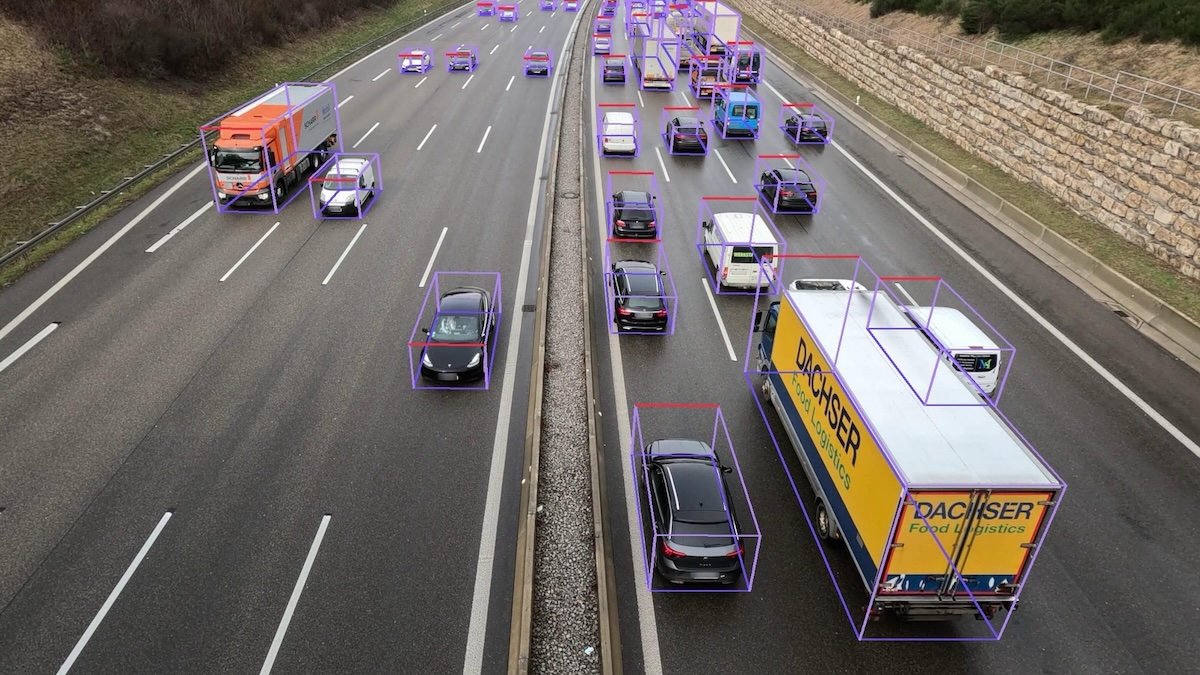
DeepScenario’s AI Scenario Engine automatically analyzes traffic videos – for example from dashcams, traffic cameras or drones – and converts them into simulation-capable, three-dimensional traffic scenarios. This means that even rare edge cases can be systematically integrated into test environments.
Business model and practical evidence
DeepScenario sells the AI Scenario Engine as a B2B software platform to automobile manufacturers and suppliers. It is provided as a cloud or on-premise solution. Billing is based on license or subscription models, supplemented by usage-dependent components, for example based on the scenarios generated or the computing power used.
Last year, users included Bosch and Mercedes-Benz. They used the technology to validate autonomous driving functions under realistic conditions and to systematically expand test coverage.
The industrial added value lies less in pure scenario generation than in scalability: real traffic data from test vehicles, infrastructure cameras or funding projects are automatically converted into simulation-capable 3D models and are immediately available for virtual test runs. Field tests can thus be supplemented in a targeted manner without having to physically reproduce every scenario.
Core features of the AI Scenario Engine
Monocular computer vision: The system detects and tracks vehicles, pedestrians and other road users in video data from individual cameras. Movement trajectories and object relationships are reconstructed from two-dimensional image sequences.
- Scenario mining: Traffic sequences – such as braking, turning or overtaking maneuvers – are extracted from video data and depicted in a spatial-temporal model. This creates statistically representative test scenarios based on real traffic observations.
- Generative traffic models: A learning-based model maps regional driving patterns and uses them to create new, simulation-capable traffic situations. The goal is to systematically expand real data distributions without relying solely on synthetic assumptions.
“What sets the AI Scenario Engine apart from other solutions is our scenario mining process,” explains Holger Banzhaf, CEO and co-founder of DeepScenario in an interview with Munich startup.
We use our groundbreaking image processing algorithms to gain access to representative distributions of the real world in all three spatial dimensions and the time dimension.
Classification and added value
The practical benefit lies primarily in the scaling of realistic tests: Virtual scenarios can be generated in large numbers and varied systematically. This allows development cycles to be shortened and the effort required for physical test drives to be reduced.
Whether this results in significant cost advantages or security gains depends on the depth of integration into existing test architectures and regulatory recognition processes.
In the competitive environment, DeepScenario positions itself against providers such as Cognata and Parallel Domain with the claim of directly converting real video data into simulation-capable 3D scenarios. The core of the approach addresses a structural conflict of objectives in the industry: How can tests be scaled and designed realistically at the same time?
Scaling: market, capital and application areas
In October 2022, DeepScenario completed a financing round with the High-Tech Gründerfonds (HTGF) and MobilityFund as well as several business angels. The exact amount has not been publicly quantified. The capital is used to expand the platform, internationalization and further integration into industrial test environments.
Strategically, the focus remains on the automotive industry – a market in which validation capacities are becoming a bottleneck factor as automation increases. At the same time, the company is examining areas of application in smart city infrastructures and traffic management, where the analysis of real traffic data also plays a role.
As the complexity of autonomous driving functions increases, the regulatory and economic pressure to increase test coverage and at the same time shorten development cycles increases. For providers like DeepScenario, scaling is not just based on technological performance, but also on integration ability, standardization and industrial connectivity.
DeepScenario: Between innovation demands and industrial testing
DeepScenario addresses a structural bottleneck in the development of autonomous systems: the scaling of realistic test scenarios under economic and regulatory conditions. The approach of systematically converting real traffic data into simulation-capable 3D models is based precisely on the trade-off between test coverage and effort.
With investors such as HTGF and MobilityFund as well as the first industrial users, the start-up is positioning itself as a specialized provider in the area of data-driven scenario generation.
The decisive factor will be the extent to which the technology can be integrated into existing test architectures and meets regulatory requirements. If this succeeds, the AI Scenario Engine can become a relevant component in the validation of autonomous driving functions.
Also interesting:
- Patients instead of paperwork: German company brings AI to hospitals
- Turning gas into electricity: reversible power plants with fuel cells
- The Exploration Company: Europe on the way to its own space logistics
- SkoneLabs: How AI should ensure fresh food
The post AI company wants to have solved the biggest problem of autonomous cars appeared first on BASIC thinking. Follow us too Google News and Flipboard or subscribe to our newsletter UPDATE.
As a Tech Industry expert, I approach claims of solving the biggest problem facing autonomous cars with caution and skepticism. The field of autonomous driving is incredibly complex and involves a multitude of challenges, from navigating unpredictable environments to ensuring the safety of passengers and pedestrians.
While AI companies may make bold claims about having solved these problems, it’s important to thoroughly evaluate the technology and consider the potential limitations and risks. Autonomous driving systems must be rigorously tested and proven to perform safely and reliably in a variety of real-world scenarios before they can be trusted on a large scale.
It’s also important to consider the ethical implications of autonomous driving technology and the potential impact on society. As we continue to advance in this field, it’s crucial to prioritize safety, transparency, and accountability to ensure that autonomous cars can truly deliver on their promise of revolutionizing transportation.
Credits