The article Real or AI? When reality comes under suspicion was first published by the online magazine BASIC thinking. With our newsletter UPDATE you can start the day well informed every morning.
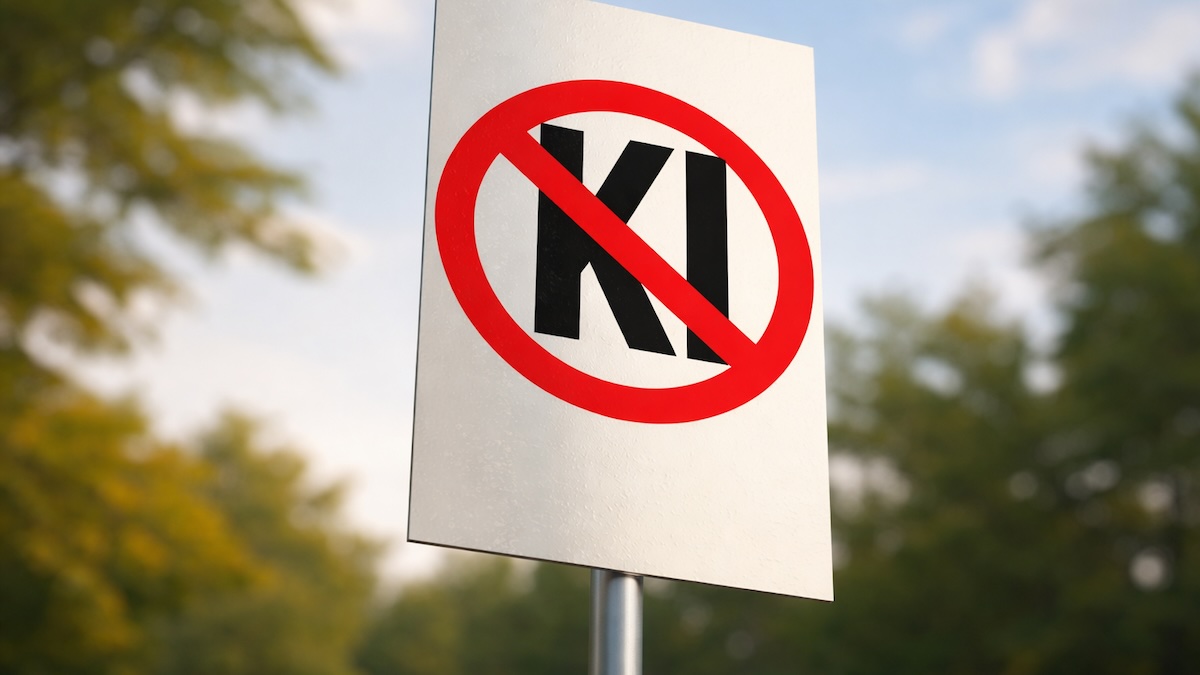
Is this real or AI? Artificial intelligence content is gradually destroying our trust in images, videos, voices and articles. So does content have to become more human again? It’s not that simple.
Maybe you’re familiar with this: You’re scrolling through social media channels and not only are the bad content getting on your nerves, but you’re also growing suspicious that nothing could be real anymore.
One could hastily dismiss the ever-increasing skepticism towards AI-generated content as a pessimistic overreaction: “Content generated by humans is just better, we’ve always known that!”
However, anyone who reacts irritably or even negatively to artificially generated images, videos or voices today is not automatically anti-technology. In my opinion, he or she is rather reacting to a change in the digital environment that many people have long felt, even if they cannot yet clearly name it.
Real vs. AI: What’s the problem?
The problem is not just that AI can now generate deceptively real content. The bigger problem is that this AI-generated content is changing the way we view digital content overall.
Where there used to be a certain basic trust, today there is increasingly a quiet mistrust: Is the content real? Is it edited? Is it staged? Was it perhaps no longer created by a human?
This is so remarkable because for a long time the strength of AI was located somewhere else entirely. It was about efficiency, about productivity, about new creative possibilities, about relieving people’s workload.
None of this is wrong. But this perspective falls short. Because AI doesn’t just change how content is created. It also changes how we perceive and classify content.
Not all AI is the problem
Before I elaborate, however, a word of caution is required. My point is not to say that every use of AI is problematic. That would be strange, as in my lectures and workshops I am almost an AI optimist who despairs of Germany’s unwillingness to change.
So if AI helps to structure information, smooth texts linguistically, accelerate processes or make knowledge more quickly accessible, it is extremely useful.
Many of the current applications today are precisely in this area and thus support human work. The impression of reality is not undermined.
Rather, it becomes critical where AI is no longer just a tool in the background, but visibly replaces human reality. When faces, voices, scenes or entire moods are artificially created, it is no longer just about support. Then it’s about simulation. And it’s exactly at this point – that’s how it seems to me at the moment – that the feeling changes for many people.
In my opinion, a linguistically improved text and an artificially created human being are not the same thing. An AI that sorts in the background is different than an AI that imitates reality in the foreground. Those who make this distinction better understand why some applications cause little resistance, while others immediately cause discomfort.
No AI please: Why the real thing suddenly becomes important again
I think we are currently experiencing a backlash against interchangeability when people complain about AI. We don’t see a lot of AI content as problematic because it’s technically bad.
On the contrary: they are often surprisingly well made. But that is often exactly where the problem lies. They seem slick, generic and too effortless. So they don’t lack quality in the technical sense, but they lack friction, uniqueness and “edge”.
The real thing does not become more attractive in the environment of a variety of AI content because it is always nicer or better. The opposite is now often the case. It becomes more attractive because it becomes more scarce.
If artificial production is possible in almost unlimited quantities, then what cannot be scaled at will becomes more valuable: human experience, real perspective, concrete handwriting, vagueness, contradiction, attitude.
That’s exactly why I don’t think the saying “No AI please” is backwards. Rather, it shows that people can sense when technology is helping them and when it is beginning to change the character of content. Perhaps this is a sign of oversaturation, perhaps even of growing digital maturity.
The real problem is the loss of trust
But another point seems even more important to me. The real danger is not that people are deceived by individual AI content. In my opinion, it lies in the fact that the distrust grows beyond the individual content.
When people begin to not only look at artificial things critically, but also reflexively suspect that real things were created by AI, then the entire perception of the digital public essentially changes.
This reminds me of another problem that I have already written about, namely digital education and the handling of information: knowledge is available in large quantities today, but many people find it difficult to classify information, to grasp it in its entirety and not to be driven by volume or emotions.
AI is now exacerbating this problem even further. Now it is no longer just about classifying information, but increasingly also about classifying “reality”, i.e. whether something is genuine or artificially created.
If this development continues, we could end up with an environment in which authenticity is no longer assumed – as before – but must be justified. This is a significant change.
Because trust is already fragile digitally. If the visual, acoustic and linguistic levels can now be synthesized across the board, then the pressure on the individual user to always have to check what content they actually have in front of them increases.
The return to authenticity is not innocent either
But I don’t want to fall into a romanticization of the real thing. Because even the new desire for authenticity is not free from staging. It can already be observed that “without AI” itself becomes a labelthat creates attention and can be marketed.
This shows that the topic is more complicated than it seems at first glance. Not every distancing from AI is an expression of a deep attitude. Some of it is strategy. Just as “with AI” was recently considered proof of innovation, “without AI” is now used as a seal of quality.
So in my opinion we have to be careful when classifying them. AI is neither generally the enemy of humanity nor is everything human automatically more valuable. What matters more is whether content and technologies are used in a way that strengthens or undermines trust.
Real or AI? What matters now
In my opinion, we need less blanket enthusiasm for AI and less blanket anti-AI in the future. Instead, we need the ability to recognize differences.
Where does AI provide useful support? Where does it replace something that shouldn’t be replaced? Where does it expand human possibilities? And where does it primarily produce mass and surface stimuli?
These are all questions aimed at media literacy and judgment. If we are not aware of how AI-generated content affects our trust in content in general, then we are talking too superficially about the benefits of AI.
Maybe that’s exactly the uncomfortable point of this development: AI doesn’t just force us to think about machines. It forces us to think anew about the human condition and what we actually mean when we believe something to be real.
And perhaps this is precisely where the real challenge of the coming years lies: whether we manage, in a world full of synthetic possibilities, not to lose the standards by which we recognize, evaluate and trust reality. This is exactly what will decide whether AI really improves our digital everyday life or just makes it even more artificial.
Also interesting:
- The biggest mistakes in ChatGPT: Why almost everyone uses AI incorrectly
- EU Inc.: Founding a company in 48 hours – Europe is planning the fastest company in the world
- How AI is driving courts crazy
- EU Inc.: A European dream – and the German reality
The article Real or AI? When reality comes under suspicion appeared first on BASIC thinking. Follow us too Google News and Flipboard or subscribe to our newsletter UPDATE.
As a Tech Industry expert, I believe that the question of whether something is real or artificial intelligence is becoming increasingly blurred in today’s world. With advancements in AI technology, it is becoming more difficult to distinguish between what is created by human intelligence and what is generated by machines.
This raises important ethical and philosophical questions about the implications of AI on society. As AI becomes more sophisticated, there is the potential for it to be used to manipulate information and deceive people. This could have serious consequences for trust and credibility in our increasingly digital world.
It is important for companies and individuals to be transparent about the use of AI technology and to ensure that it is used ethically and responsibly. As we navigate this new era of AI, we must be vigilant in questioning the authenticity of information and be critical thinkers in evaluating what is real and what is artificial.
Credits