The article Turning gas into electricity: Reversible power plants with fuel cells first appeared in the online magazine BASIC thinking. With our newsletter UPDATE you can start the day well informed every morning.
In the series “Start-up Check!” We regularly examine the business models of start-ups. What is behind the company? What makes the start-up so special and what is there to criticize? Today: Reverion.
Start-ups: That sounds like inventiveness, future technologies, new markets. But in reality, many of the start-ups unfortunately often turn out to be a mixture of an e-commerce idea, haphazard founders and shaky future prospects.
They certainly do exist: the thought leaders who work on the big problems and revolutionize business models. Finding and presenting them is the task of the Start-up Check format. Today: The climate tech start-up Reverion.
What is Reverion?
- Industry: Climate Tech, Clean Tech/Energy
- founder: Felix Fischer, Maximilian Hauck, Stephan Herrmann, Luis Poblotzki
- Founding: 2022 as a spinoff from the TU Munich
- product: Containerized modules (around 100 kilowatts/500 kilowatts) for biogas and H₂ operation
The UN climate conference in Belém, Brazil, ended at the end of November. The negotiators achieved a compromise with the so-called “Belém Package”, but at the same time central questions remained controversial. These include, for example, concrete timetables for phasing out fossil fuels and reducing CO2.
In any case, it became clear once again in Belém: technological solutions are needed that can be industrialized quickly – and not just pretty pilot projects. Technologies that couple power generation with net negative emissions while delivering system flexibility are now high on the agenda.
The Munich start-up Reverion promises exactly this combination.
The team around the founders Felix Fischer, Maximilian Hauck, Stephan Herrmann and Luis Poblotzki develops and industrializes reversible, CO2-negative small power plants based on high-temperature fuel cells. The systems convert biogas or hydrogen into electricity with very high electrical efficiencies (up to around 80 percent).
In reverse mode, the same modules function as electrolyzers and produce green hydrogen or synthetic methane from excess electricity. Power-to-gas and gas-to-power combined in one system: that is the core of the product promise.
Reverion: Technology compact
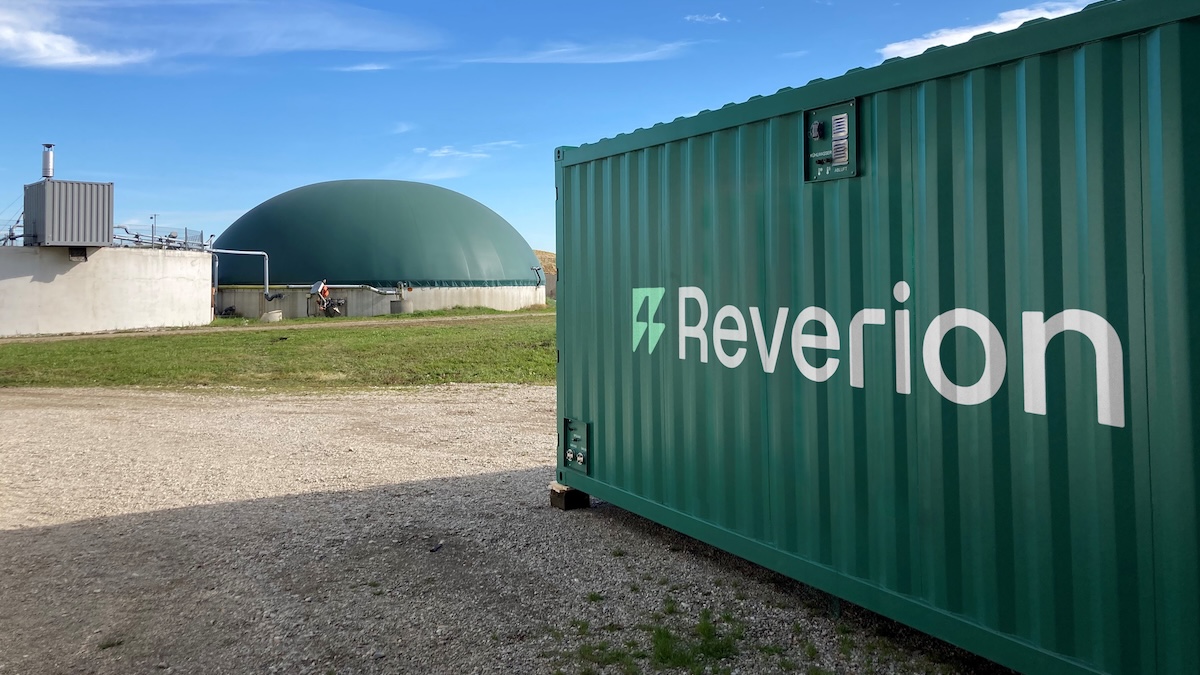
The technology is based on so-called solid oxide fuel cells (SOFC) and solid oxide electrolyzers (SOEC) in a patented, closed process with its own control logic. In practical terms, this means that Reverion delivers containerized modules that can be flexibly integrated into existing energy or biogas infrastructures.
For example, 100 kilowatts can be realized in a 20-foot container or 500 kilowatts in a 40-foot container. A central unique selling point is the capture of almost pure biogenic CO2 during electricity generation. This CO2 can be stored (CCS) or used (CCU), enabling net negative emissions.
Business model and customers
Reverion addresses operators of biogas plants (farmers and regional energy suppliers), industrial sites as well as offtakers who want to purchase CO2 removals.
Instead of individual devices, the company sells modular power plant solutions including long-term services. These include operator models, power-to-gas integration and CO2 offtake contracts.
The result for operators is higher electricity output from the same amount of biogas, new revenue streams through CO2 sales and greater system flexibility through bidirectional use.
Financing and international partners
Since being founded as a TUM spin-off (Technical University of Munich) in 2022, Reverion has gone through several rounds of financing: a seed round of around seven million euros and in 2024 a Series A round of around 56 million euros, which was led by Energy Impact Partners. Those involved included Honda, Extantia, UVC Partners and various climate VCs.
In addition, Reverion received funding, including: EU Innovation Fund Grant amounting to around 19.5 million euros for the RESILIENCE project. The aim of the project is to scale the production of modular, container-based power plants and thus make a decisive contribution to the decarbonization of the biogas industry.
There are also prize money (e.g. XPRIZE) and offtake agreements. For example, there are binding contracts for biogas-based CO₂ removal with partners such as Frontier, which secure delivery volumes for many years.
Production and scaling
Reverion is building a production site in Eresing (Bavaria), which will be used for the series production of container solutions. With a pre-order volume of 90 to 100 million euros already confirmed, the company is aiming for a quick roll-out in Europe.
The integration of manufacturing, pre-orders and funding reduces market entry risks, but also presents the challenge of ramping up production, quality assurance and after-sales in a short time.
Conclusion: Efficient power plants for clean energy and negative emissions
The Munich start-up combines sophisticated research with commercial ambition: The technology is clever and solves two problems at once: clean electricity production and CO2 removal. With Series A capital, EU funding and the first large orders, the path to the industrial phase is clear.
The coming months will show whether system availability, service life and costs in series production meet expectations. If successful, Reverion can become an important piece of the puzzle for a renewable, climate-tolerant energy system.
Also interesting:
- The Exploration Company: Europe on the way to its own space logistics
- SkoneLabs: How AI should ensure fresh food
- Tactile: German AI start-up wants to transform the financial industry
- Freshflow: Using AI to combat food waste
The article Turning gas into electricity: Reversible power plants with fuel cells appeared first on BASIC thinking. Follow us too Google News and Flipboard or subscribe to our newsletter UPDATE.
As a Tech Industry expert, I believe that the concept of turning gas into electricity through reversible power plants with fuel cells has significant potential for revolutionizing the energy industry. Fuel cells have long been recognized as a clean and efficient way to generate electricity, but the ability to reverse the process and convert excess electricity back into gas for storage or distribution is a game-changer.
This technology has the potential to address some of the key challenges facing renewable energy sources, such as intermittency and storage issues. By utilizing reversible power plants with fuel cells, we can store excess electricity generated from solar or wind power during peak production times and convert it back into gas when needed, providing a reliable and sustainable energy source.
Furthermore, this technology has the potential to reduce greenhouse gas emissions and reliance on fossil fuels by utilizing clean gases such as hydrogen or methane. This could have significant environmental benefits and help to combat climate change.
Overall, I believe that reversible power plants with fuel cells have the potential to disrupt the energy industry and pave the way for a more sustainable and efficient energy future. It will be exciting to see how this technology develops and is adopted on a larger scale in the coming years.
Credits