The article Researchers achieve a superconductor record – for loss-free power transmission first appeared in the online magazine BASIC thinking. With our newsletter UPDATE you can start the day well informed every morning.
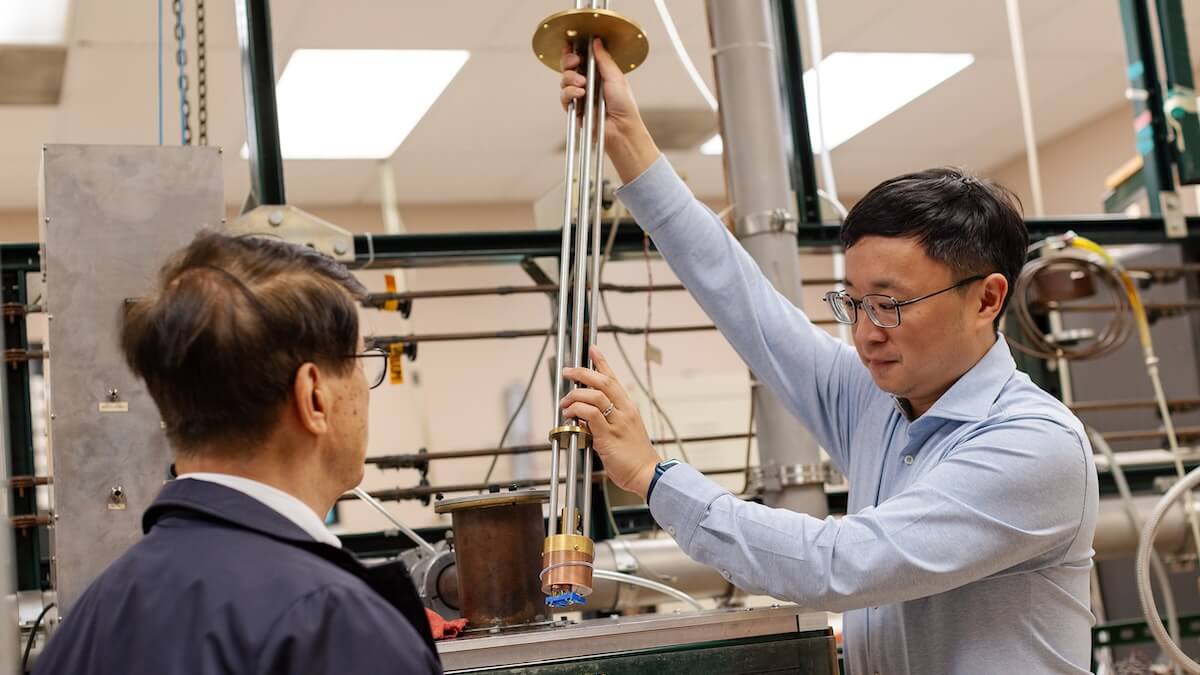
Physicists at the University of Houston have achieved a new record in superconductivity. You can now allow electricity to flow without loss under much simpler conditions. The particularly efficient energy supply is not yet suitable for everyday use, but this breakthrough brings it a lot closer.
Energy is rarely generated where it is actually needed. Power plants, wind farms or solar systems are often located far away from households or industrial facilities that rely on a reliable supply.
Therefore, energy must be transported over long distances in order to balance supply and demand and ensure a stable supply. However, a significant amount of energy is lost during this transport process, for example in power lines.
The reason for this lies in the electrical resistance of the materials. As current flows through the wires, electrons collide with atoms, releasing some of the energy in the form of heat.
These losses add up when electricity has to travel long distances, making energy transmission inefficient and expensive. A solution to this problem is superconductors, i.e. materials in which electrical resistance completely disappears, allowing current to flow without losses.
Physicist at the University of Houston have now achieved a breakthrough in their research that enables superconductivity under much more practical conditions. A development that could mean enormous potential for power grids and a more sustainable energy economy.
Researchers achieve temperature record for superconductivity
Superconductivity was discovered back in 1911, and scientists have now made significant progress. This discovery could bring the field a big step closer to practical applications.
Researchers from the Texas Center for Superconductivity and the University of Houston’s Department of Physics were able to set a new temperature record for superconductivity under ambient pressure. This is particularly advantageous because most superconductors currently have to be cooled to extremely low temperatures, which makes them expensive and difficult to use.
In their work, the scientists achieved a transition temperature of 151 Kelvin, i.e. around minus 122 degrees Celsius. The previous record from 1993 was 133 Kelvin, i.e. minus 140 degrees Celsius. This temperature describes the point below which a material becomes superconducting and current can flow without resistance.
“About eight percent of the energy is lost when electricity is transmitted in the network,” explains physics professor and lead author Ching-Wu Chu. “If we save this energy, we save billions of dollars, significantly reduce expenditure and protect the environment.”
Increasing the transition temperature is a crucial factor. The closer this can be brought to room temperature, the more practical and cost-effective superconducting technologies could become.
Pressure quenching enables temperature record for superconductivity
The development is based on a “pressure quenching” technique. This is already being used in areas such as diamond production.
For this process, the researchers first subjected the material to strong pressure in order to improve its superconducting properties and increase its transition temperature. While the material is under pressure, it is cooled to a certain temperature and then quickly and completely released from the pressure.
This process fixes the improved superconducting properties and keeps the material stable under normal conditions. The higher transition temperature also remains after the pressure has been removed.
“This discovery has great potential,” said Chu. “We are convinced that with enough researchers and enough time we can exploit this potential.”
Superconductivity at ambient pressure and room temperature of around 300 Kelvin therefore remains the ultimate goal. Nevertheless, according to the researchers, the new record is an important advance and a significant discovery for superconductivity research.
Also interesting:
- 120-year-old idea: Researchers modernize Edison’s nickel-iron battery
- Electricity from wastewater: Microbes turn sewage treatment plants into green energy sources
- Gas cost trap? Study warns of risk of billions from new gas power plants
- Simply explained: How does a wind turbine actually work?
The post Researchers achieve superconductor record – for loss-free power transmission appeared first on BASIC thinking. Follow us too Google News and Flipboard or subscribe to our newsletter UPDATE.
As a Tech Industry expert, I am incredibly excited about the recent achievement of researchers in achieving a superconductor record for loss-free power transmission. This breakthrough has the potential to revolutionize the way we transmit and distribute electricity, making our electrical grids more efficient and reliable.
Superconductors have long been seen as a promising technology for power transmission due to their ability to carry electricity without resistance. However, the challenge has always been to find superconducting materials that can operate at temperatures that are practical for real-world applications.
This new record set by researchers is a significant step forward in overcoming this challenge. By demonstrating superconductivity at higher temperatures, they have opened up new possibilities for the widespread adoption of superconducting power transmission systems.
The potential benefits of loss-free power transmission are immense. Not only would it reduce energy wastage and lower electricity costs, but it could also help to make our electrical grids more resilient to outages and fluctuations in demand.
Overall, this achievement is a testament to the power of innovation and collaboration in the tech industry. I look forward to seeing how this breakthrough will be further developed and commercialized in the coming years, and the positive impact it will have on our energy infrastructure.
Credits