The article New balcony power plant standard allows 7,000 watts – but only 800 feed-in appeared first in the online magazine BASIC thinking. With our newsletter UPDATE you can start the day well informed every morning.
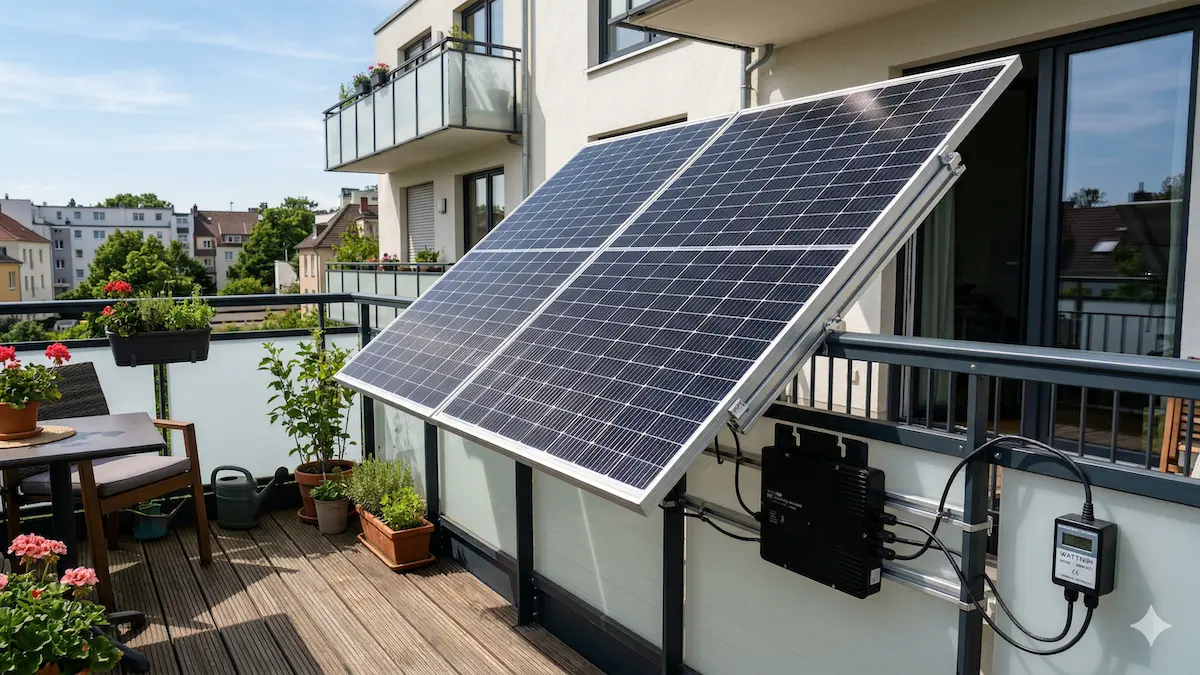
A new VDE guideline for plug-in solar devices allows module outputs of up to 7,000 watts for balcony power plants for the first time. But the feed-in limit remains at 800 watts. At the same time, new reporting and control obligations apply above certain thresholds. We explain which rules now apply, where there are still problems in practice and for whom a large system is actually worthwhile.
The new VDE guidelines for plug-in solar devices create, for the first time, clear framework conditions for the compliant operation of very powerful balcony power plants. It expands the scope of application and enables households to use larger systems in a legally secure manner. This makes it easier the norm the private energy transition and reduces electricity costs in the long term.
The new rules theoretically allow a module output of up to 7,000 watts. Nevertheless, the actual feed-in power for the inverter or storage unit remains limited to 800 watts. From an installed module output of 2,000 watts, users must also register the system with the respective network operator.
When is the network operator allowed to curtail a balcony power plant?
From an output of 7,000 watts, the installation of a smart meter gateway becomes mandatory. This device gives the network operator the technical ability to control or regulate the system remotely if necessary. This means that in the event of network problems, the operator can immediately interrupt the feed or pull the plug.
The revised standard now also allows standalone AC battery storage as a permissible component. Users can use this to temporarily store or “refuel” cheap grid electricity from variable tariffs. There is a strict ban on throttling the feed-in power using software alone for these storage systems.
7,000 watts sounds good – but that’s where it fails
In practice, the implementation of 7,000 watt systems currently fails due to a lack of storage solutions for this high performance class. Many storage units only have connections for the solar modules on the main unit, which severely limits capacity. Since only a maximum of 2,000 watts of PV input power is possible per device, there are problems with integrating large module fields.
The economic viability of such systems depends heavily on usage behavior, as self-consumption is significantly more lucrative than feeding in. The network operator currently only compensates excess electricity at around 7 cents per kilowatt hour. Anyone who doesn’t use the high output directly themselves is giving away money to the energy supplier.
Wind turbines and fuel cells: What else the new standard allows
In addition to solar power, the standard now also allows the integration of other sources such as small wind turbines or hydrogen fuel cells. In the future, combined heat and power plants can also be operated as part of a combined energy system. Such systems must also comply with the 800 VA limit when feeding in.
The electricity generated remains particularly useful for permanently running household consumers. These include cooling devices, heating systems or computers that require a constant base load. However, power-intensive applications such as charging electric cars can only be operated to a limited extent with the limited feed-in power.
Conclusion; For most households, a system of this size is currently oversized. If you don’t have suitable storage and use little electricity during the day, you’re giving away most of the energy you generate at bargain prices.
Large module outputs are particularly useful for households with high base loads, such as heat pumps or home office operations. Our advice: If you get started today, the most economical option is with 1,500 to 2,000 watts of module power and a small storage unit – and you also remain under the registration requirement.
Also interesting:
- Simply explained: How does a wind turbine actually work?
- E20: What you need to know about the new organic fuel
- Pseudo-noise and infrasound: No evidence for wind turbine myths
- Buying a used electric car: This is what you should pay attention to
The post New balcony power plant standard allows 7,000 watts – but only 800 feed-in appeared first on BASIC thinking. Follow us too Google News and Flipboard or subscribe to our newsletter UPDATE.
As a tech industry expert, I believe the new balcony power plant standard allowing for 7,000 watts is a positive step towards promoting renewable energy generation at the individual level. However, the limitation of only allowing 800 watts to be fed back into the grid may limit the potential benefits of these power plants.
It is important for regulations to strike a balance between incentivizing renewable energy generation and ensuring grid stability. Allowing for a higher feed-in capacity could encourage more people to invest in balcony power plants and contribute to the overall goal of reducing carbon emissions.
I would recommend that policymakers revisit this limitation and consider increasing the feed-in capacity to a level that is more reflective of the potential energy generation capabilities of these power plants. This could help to further incentivize individuals to invest in renewable energy technologies and contribute to a more sustainable energy future.
Credits