The article so.cool: This air conditioning system needs neither an outdoor unit nor a hose appeared first in the online magazine BASIC thinking. With our newsletter UPDATE you can start the day well informed every morning.
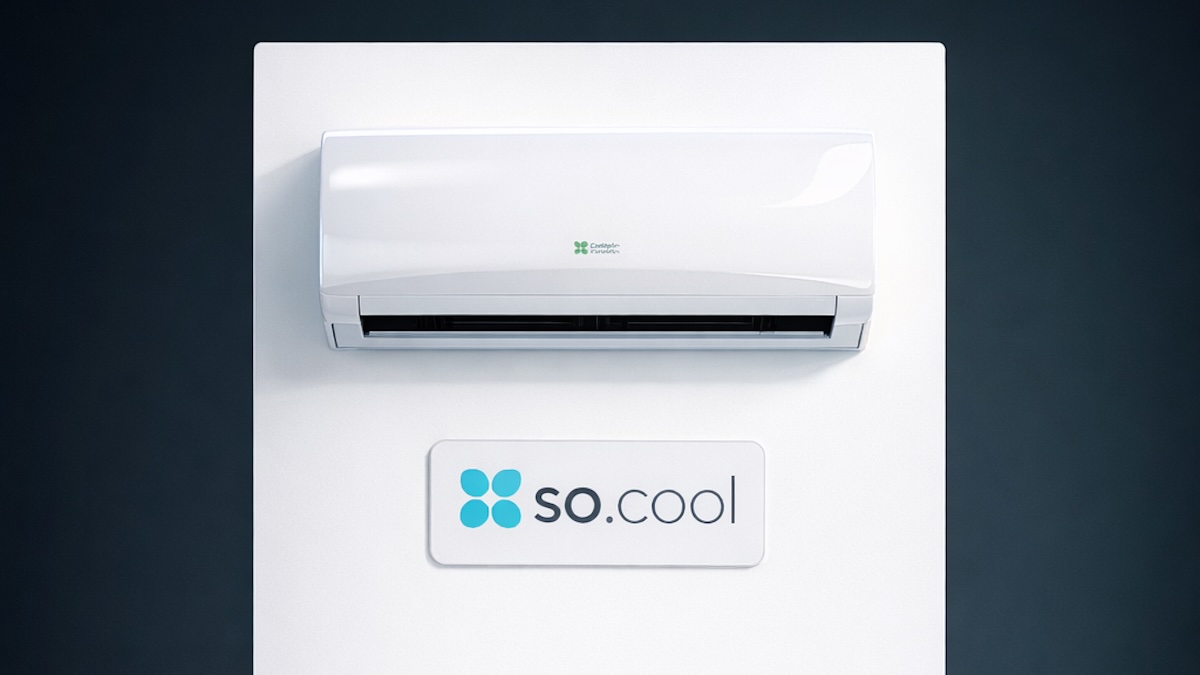
Anyone who sweats in an old building, office or classroom knows the dilemma: split air conditioning systems need an outdoor unit, while mobile units with a hose are relatively inefficient. The Viennese start-up so.cool wants to make both unnecessary – with a plug-and-play air conditioning system that stores heat in the device instead of directing it to the outside. Our start-up check shows whether the technology delivers what it promises and where the risks lie.
Start-ups: That sounds like inventiveness, future technologies, new markets. But in reality, many of the start-ups unfortunately often turn out to be a mixture of an e-commerce idea, haphazard founders and shaky future prospects.
They certainly do exist: the thought leaders who work on the big problems and revolutionize business models. Finding and presenting them is the task of the “Start-up Check” format. Today: so.cool, a DeepTech start-up in the field of air conditioning technology.
What’s behind so.cool?
- Industry: CleanTech / DeepTech / Building Technology
- Founder: Philippe Schmit
- Year founded: First prototype planned for 2024, launch in 2026
- Business model: Development of an installation-free plug-and-play air conditioning system without an outdoor unit
- Goal: Energy-efficient cooling for offices, communities and public facilities without complex installation
Anyone who lives or has lived in the attic knows what we’re talking about: On hot summer days, the heat can literally build up in old apartments, but also in offices or schools. However, retrofitting air conditioning systems is often expensive and involves complex installations.
Split air conditioning systems require external units on the facade, which are often not approved in old buildings, rental apartments or listed buildings. Mobile monoblock air conditioning systems with an exhaust hose are flexible, but inefficient – the exhaust hose allows warm air to flow in from outside and destroys the cooling effect.
The Viennese start-up so.cool – formerly Social Cooling – wants to solve this problem with a technology that it claims is unique in the world: an air conditioning system that works without an outdoor unit and without an exhaust hose. Instead of conducting the heat to the outside, it is stored in the device itself.
From the flooded apartment to the TV show
Behind so.cool is Philippe Schmit, a Luxembourg native and three-time law graduate who actually wanted to pursue a career as a lawyer. The idea for the start-up arose out of personal necessity: “I sweat at 15 degrees,” says Schmit Interview with incubator. He struggled with high temperatures in his old apartment in Vienna, but as a student he couldn’t afford conventional air conditioning.
What began as a desperate search for cooling developed into a technical vision. Schmit experimented with different cooling methods, sometimes flooding his apartment. Two years later, the vague idea had become a concrete product: TerraBreeze – a plug-and-play air conditioning system.
In spring 2026, Schmit presented his technology on the Austrian start-up show “2 Minutes 2 Million” – with success. The investors Mathias Muther and Alexander Schütz signaled interest and negotiations are currently ongoing.
This is how the air conditioning works without an outdoor unit and without a hose
The key difference to conventional air conditioning systems lies in how so.cool works: the heat is stored in the device using phase change materials.
The technology combines evaporative cooling, an ancient method, with modern technology. The centerpiece is terracotta pipes that act as heat exchangers. Indirect evaporative cooling quickly removes heat from the air without pumping moisture into the room.
The stored heat is then released again in a targeted manner: at night when no one is in the office. According to the company, two hours of downtime per day should be enough to completely unload the system.
Through this approach, so.cool promises around 40 percent less power consumption than traditional 12,000 BTU multi-split systems. The system is designed for rooms up to 50 square meters and also has integrated air purification as well as humidification and dehumidification functions.
The current generation has a cooling capacity of 5 kW. AI-controlled sensors continuously monitor room temperature, humidity and air quality and dynamically adjust cooling performance.
Patent granted: How well protected is the technology?
The technology is already legally secured: one patent has been granted, and another has received a positive patentability assessment from the FFG (Austrian Research Promotion Agency). Additionally, patents were registered in Austria and Luxembourg.
A technical report from the Vienna Institute of Building Research & Innovation (IBR&I) represented an important milestone. In a dossier, the institute confirmed the technical plausibility of the approach.
How far is so.cool from the finished product?
The current prototype is still the size of a cupboard, but the final version is expected to be 30 to 40 percent more compact. The latest generation was presented at the opening of the new location in the Seestadt Vienna technology center in March 2026
The move to TZ3 marks a crucial development step for so.cool. The interdisciplinary team now consists of founder Philippe Schmit, co-founder and physicist Ben Assa, university professor and thermodynamics expert Alireza Eslamian and simulation expert Alireza Jafarinia.
400,000 euros pre-seed: is that enough for series production?
so.cool has received a pre-seed investment of 400,000 euros. The development is additionally supported by funding. On April 1, 2026, so.cool officially started a new round of fundraising in order to get production started quickly and to finance further development paths.
The business model is clearly aimed at the B2B sector. The Terra Breeze air conditioning systems will initially be offered through direct sales, with B2B sales partners to be added later for broader market penetration. The first pilot projects are already underway – including with the Rewe Group in Cologne, the city of Vienna, Energie Steiermark and two municipalities in Luxembourg.
The price should be 3,000 euros for first-time buyers. Later, the price is expected to rise to 3,800 to 3,900 euros, but in the hope that economies of scale will reduce the price again in the medium term.
Can so.cool compete with established air conditioning technology?
With its targeted focus on offices and public facilities, so.cool is choosing a lucrative but also demanding market. Selling building technology in the B2B sector often requires long sales cycles and a high level of persuasiveness towards facility managers and decision-makers.
The core problem that so.cool addresses is real: air conditioning systems are responsible for a massive portion of the world’s energy consumption in buildings. At the same time, retrofitting existing offices and commercial spaces often involves expensive and complex installations of outdoor units.
The decisive factor will be whether so.cool can overcome the technical challenges – in particular the compaction of the device and mass production. The planned 2,000 devices sold by the end of 2026 are ambitious for a hardware start-up. Delays in market launch suggest that the path from technology to market-ready hardware is rockier than hoped.
If the Viennese start-up succeeds in ramping up production and convincing its first major customers, so.cool could become a serious alternative in a market that urgently needs energy-efficient solutions. However, there is still no evidence that DeepTech innovation also works in the area of building technology without US scaling.
Also interesting:
- planqc: Munich start-up supplies quantum computers to the state
- Marvel Fusion: Munich start-up wants to bring the sun to earth
- AI company claims to have solved the biggest problem of autonomous cars
- Patients instead of paperwork: German company brings AI to hospitals
The post so.cool: This air conditioning system needs neither an outdoor unit nor a hose appeared first on BASIC thinking. Follow us too Google News and Flipboard or subscribe to our newsletter UPDATE.
As a Tech Industry expert, I would say that so.cool’s air conditioning system sounds like a revolutionary and innovative product. The fact that it does not require an outdoor unit or hose makes it much more convenient and versatile for consumers. This could potentially disrupt the traditional air conditioning market and provide a more energy-efficient and cost-effective solution for cooling homes and buildings. I would be interested in learning more about the technology behind so.cool and how it compares to traditional air conditioning systems in terms of performance, efficiency, and longevity. Overall, I believe that this product has the potential to make a significant impact in the HVAC industry and provide a more sustainable cooling option for consumers.
Credits