The article Without platinum: New catalyst makes hydrogen significantly cheaper appeared first in the online magazine BASIC thinking. With our newsletter UPDATE you can start the day well informed every morning.
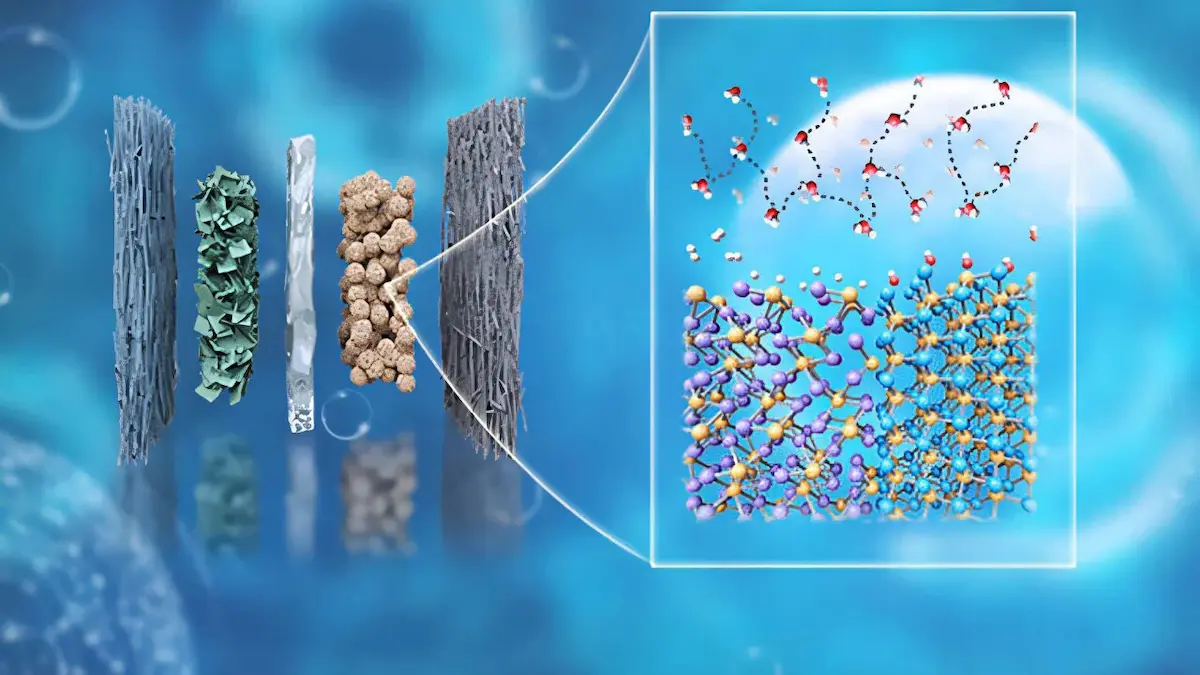
Green hydrogen could be a key to the energy transition. But so far, expensive precious metals such as platinum have slowed down large-scale production. Researchers at Washington University in St. Louis have now developed a catalyst that completely dispenses with platinum group metals and is still more powerful. In the test, the system ran stably for over 1,000 hours.
Hydrogen is considered a promising and clean fuel. It can store renewable energy and does not produce harmful carbon emissions when used. However, current hydrogen production plants rely largely on rare and expensive metals from the platinum group. The search for cheaper alternatives is therefore considered an important step in making renewable energy storage practical on a large scale.
New hydrogen catalyst: How two inexpensive materials replace platinum
A team of researchers at Washington University in St. Louis now has a solution presented. Under the leadership of Professor Gang Wu, the scientists developed a novel heterostructure catalyst. The system uses renewable electricity to split water into hydrogen and oxygen in an electrolyzer. The catalyst does not use platinum-based materials, potentially reducing production costs.
The researchers combined rhenium phosphide with molybdenum phosphide to create a new composite catalyst. The two components work closely together to improve the extraction of the gas. Rhenium supports the accumulation and release of hydrogen, while molybdenum accelerates the splitting of water. This choice of material supports the process in the alkaline electrolyte solution and supplies it with protons.
Stable for over 1,000 hours: What the catalyst achieved in tests
In combination with a nickel-iron anode, the catalyst outperformed conventional materials and the comparable value for platinum metals. The scientists also showed that the system worked at industrial current densities of one to two amperes per square centimeter. It ran consistently stable for more than a thousand hours. This makes the development one of the longest-lasting platinum-free cathodes for anion exchange membrane water electrolyzers.
The technology promises practical use as it can make electricity from sunlight, wind or water storable. The hydrogen produced could be used as an energy source for various chemical industries and manufacturing. The previous experiments took place on a laboratory scale, which is why the team is now planning studies on an industrial scale. Professor Gang Wu said:
Our findings allowed us to rationalize the crucial role of the hydrogen bond network at the catalyst-electrolyte interface. Our catalyst showed the lowest resistance, indicating the fastest hydrogen uptake among the materials examined. These performance values make it one of the most promising assemblies for practical water electrolyzers.
Also interesting:
- Register a balcony power plant: This is how you avoid a fine of up to 50,000 euros
- Balcony power plant with 7,000 watts: Who is the new VDE rule worthwhile for?
- PV system: payback in 10 years? An honest calculation
- Mini wind turbine for the home: Why the yields are often disappointing
The article Without platinum: New catalyst makes hydrogen significantly cheaper appeared first on BASIC thinking. Follow us too Google News and Flipboard or subscribe to our newsletter UPDATE.
As a tech industry expert, I am excited about the development of a new catalyst that can make hydrogen production significantly cheaper without the use of platinum. Platinum is a precious metal that is expensive and in limited supply, so finding alternative catalysts is crucial for scaling up hydrogen production for use in fuel cells and other applications.
The use of this new catalyst could potentially lower the cost of producing hydrogen, making it more accessible and widely adopted as a clean energy source. This could have a significant impact on reducing carbon emissions and transitioning to a more sustainable energy future.
I am interested in learning more about the performance and durability of this new catalyst, as well as the scalability of production. If this technology proves to be successful, it could be a game-changer for the hydrogen industry and accelerate the transition to a carbon-neutral economy. I will be following closely to see how this innovation progresses and the potential implications for the tech industry as a whole.
Credits