The article Synthetic Biology: Will AI be the next savior – or kill us all? first appeared in the online magazine BASIC thinking. With our newsletter UPDATE you can start the day well informed every morning.
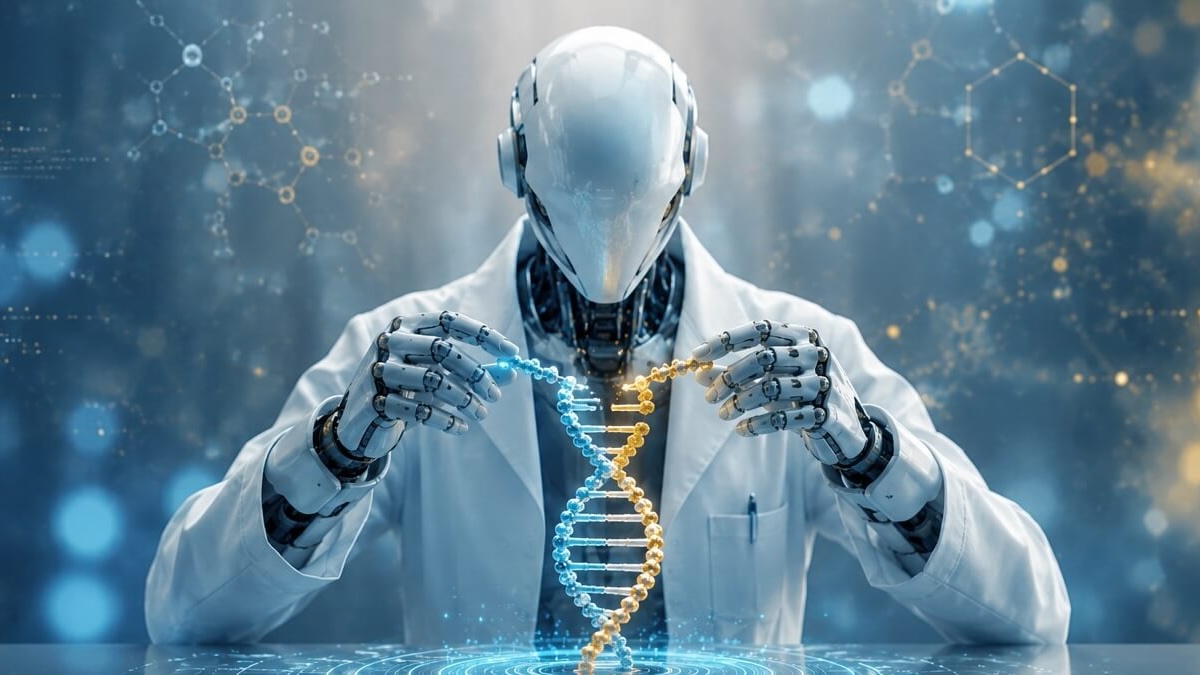
AI models are already designing vaccines, predicting protein structures and writing work instructions for laboratory robots. What sounds like science fiction has long been part of everyday research life, but in addition to enormous potential, it also harbors considerable risks. At the 28th Leopoldina Lecture in Hanover, renowned scientists discussed where the boundaries lie between medical progress and biological danger. A commentary analysis.
What AI can already do in synthetic biology today
- AI models can predict its three-dimensional structure based on a gene sequence that contains the instructions for building a protein. In addition, it is already possible to derive gene sequences from imaginary protein structures. Both can help researchers, for example To develop an inhibitor for a specific enzyme or to change the binding of viruses. Using language models, scientists are increasingly understanding how the genome of organisms is encoded. AI can, for example, design a genome that has a relatively high probability of encoding a viable organism.
- In synthetic biology, researchers modify organisms for specific purposes. For example, to use it as a tool in research, as a vaccine or even as a therapeutic agent. With the help of manipulated organisms, for example, Fight pathogens. AI models can not only provide support, but can also significantly accelerate processes. Scientists at the University of Cambridge recently used artificial intelligence to develop a so-called super antigen for the human immune system using computer simulations. The result is a vaccine that should not only be able to combat already known viruses, but also future mutations.
- In synthetic biology, AI primarily helps interpret large amounts of data, which would take humans much longer. Specially trained models can even generate hypotheses so researchers can test them more quickly to generate knowledge. In the meantime AI systems even write work instructions for laboratory robotswho carry out experiments. This saves scientists a lot of time that they can use elsewhere. However, it is always crucial to critically evaluate such experiments. Similar to many other areas.
Synthetic Biology: Why the Same AI Can Heal and Harm
The fusion of AI and synthetic biology represents not an ordinary technological leap, but a new quality of scientific acceleration. Because where there was once a gap of several years between hypothesis, laboratory tests and results, development cycles are shrinking due to AI for a few months or even weeks.
The raw material for this progress is not pipettes or test tubes, but rather data, computing power and specially trained AI models. But this development also reveals one thing narrow tightrope walk. The same systems that can help researchers develop drugs and vaccines more quickly also lower the hurdles for applications whose consequences are difficult to predict.
In other words, in the worst case scenario, AI models could also be used or misused to make pathogens more contagious or to develop biological weapons. In addition, AI experiments must be strictly controlled and monitored. For example, to guarantee that medications or vaccines are really safe.
Ultimately, however, the debate should neither slide into technology euphoria nor doom rhetoric. Because AI is neither a savior nor a digital Dr. Frankenstein. The decisive factor will be whether society, politics and science can keep up with the pace of development. In other words: create regulations and, above all, ensure transparency.
Voices
- Bettina Rockenbach, President of the German Academy of Natural Sciences Leopoldinato Welcome to the 28th Leopoldina Lecture in Hanover: “The rapid progress in artificial intelligence and synthetic biology opens up fascinating opportunities for medical research. But critical questions also arise: Will it soon be easier to design dangerous pathogens?” Una Jakob, research group leader at the Leibniz Institute for Peace and Conflict Research (PRIF), warns: “Who is ultimately responsible if something goes wrong, if damage occurs?”
- Jens Bohne, research group leader and representative for biological safety at the Hannover Medical Schoolwould take such risks prefer to nip it in the bud: “It is important to make young people aware of the potential risks of research during their training. If necessary, they decide: STOP. This far and no further.” Una Jakob sees it similarly: “Individual decisions are required on a case-by-case basis in order to maintain the potential benefits. Regulation must not come into conflict with freedom of research.”
- A cross-university one Research group led by the epidemiologist Tom Inglesby warns as part of a study: “Due to their universal nature, the same biological AI model that can be used to develop a harmless viral vector for gene therapy could also be used to develop a more pathogenic virus capable of evading immunity. Voluntary commitments to assess the potential for danger are useful and important, but are not enough. There is a need for (…) binding regulations that prevent biological models from contributing significantly to large-scale threats, such as the creation of novel or enhanced pathogens that cause major… “Can trigger epidemics or even pandemics.”
From explorer to AI curator: This is how research is changing
In the next few years, synthetic biology could diversify from an already data-driven science transform into an AI-driven development platform. Language models will then not only analyze biological structures, but will increasingly independently provide suggestions for experiments, active ingredients or genetic constructs.
Researchers will not be replaced by this, but they will have to reinvent themselves. Namely from explorer to critical AI curator. At the same time, however, the pressure to create binding rules of the game will also increase. The question will not be whether biological AI needs to be regulated, but how.
Because: Requirements that are too strict could Slowing down innovation and researchwhile controls that are too lax could pose new risks. This threatens to create a political balancing act between freedom of research and security interests that is far more complicated than debates about data protection or copyright.
In the long term, the success of artificial synthetic biology will probably not only be based on performance, but also decide based on trustworthiness. Because if AI one day helps design vaccines, therapies or even entire biological systems, transparency will become a crucial factor. Greetings from the corona pandemic.
Also interesting:
- E-car bonus: No China shock – what the numbers really show
- AI songs are flooding Spotify and Co. – because the platforms are failing
- Who is liable if AI lies – and people are harmed?
- Network operators are raking in record profits – on the backs of consumers
The article Synthetic Biology: Will AI be the next savior – or kill us all? first appeared on BASIC thinking. Follow us too Google News and Flipboard or subscribe to our newsletter UPDATE.
As a Tech Industry expert, I believe that synthetic biology has the potential to greatly benefit society by revolutionizing healthcare, agriculture, and environmental sustainability. AI can play a crucial role in advancing synthetic biology by accelerating research, improving efficiency, and optimizing processes.
While there are concerns about the potential risks and ethical implications of synthetic biology and AI, it is important to approach these technologies with caution and responsibility. Proper regulation, oversight, and transparency are key to ensuring that they are used for the greater good and do not pose a threat to humanity.
Ultimately, I believe that with the right precautions and ethical guidelines in place, AI can be a powerful tool in unlocking the potential of synthetic biology to address some of the most pressing challenges facing our planet. It is up to us as industry experts, researchers, policymakers, and society as a whole to ensure that these technologies are used for the benefit of all.
Credits