The article Dresden researchers develop water mist cooling for buildings first appeared in the online magazine BASIC thinking. With our newsletter UPDATE you can start the day well informed every morning.
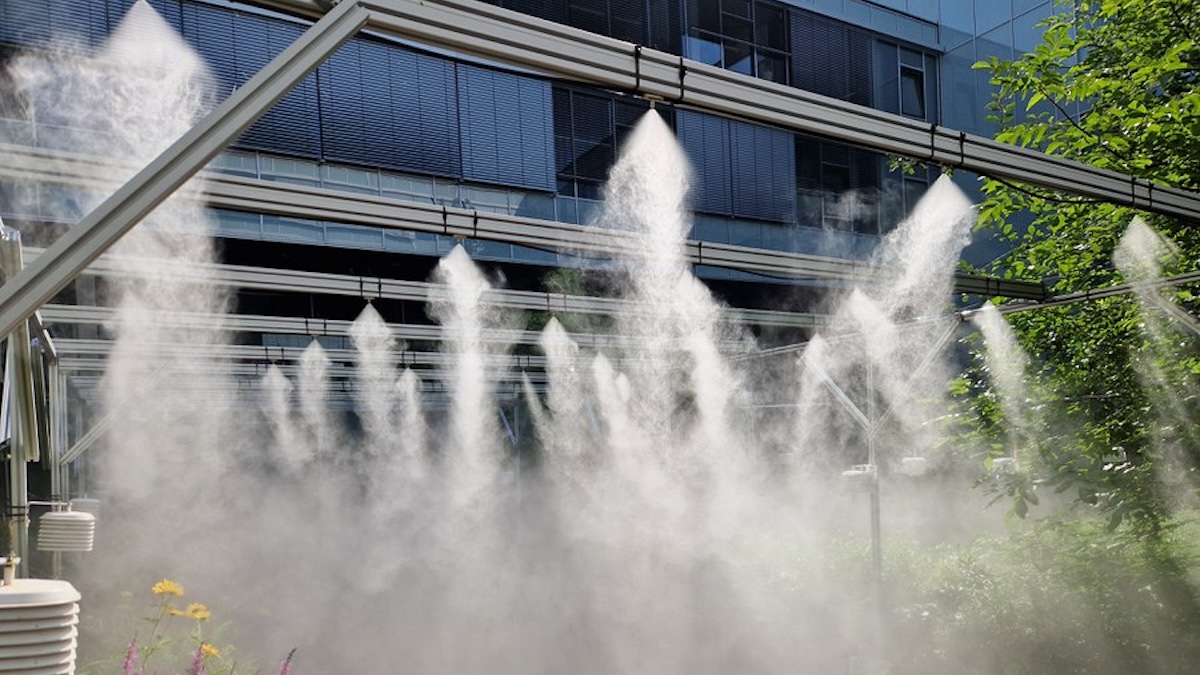
The increasing heat load in metropolitan areas makes it more difficult to cool buildings and puts a strain on human performance. A research project at the Technical University of Dresden is therefore investigating the potential for urban cooling in densely built-up courtyards. Water mist could reduce temperatures and minimize the need for drinking water through adapted rainwater management.
In typical urban living and working environments, tropical nights increasingly mean that buildings and rooms barely cool down. Classic block structures are particularly badly affected by this development in urban areas.
The inner courtyards there have so far hardly contributed to natural cooling due to sparse vegetation, intensive heat storage and a lack of radiation at night. As a result, health risks and economic burdens for the population are increasing.
To keep you cool, Research experts from the Technical University of Dresden the targeted use of water-based atomization systems in affected courtyards. The technical systems are intended to guarantee a supply of pre-cooled air through water mist during the day in order to reduce the cooling requirements of the surrounding buildings. The process could accelerate cooling during the night hours. This could create new oases in densely built-up open spaces.
Atomization systems: Where water mist can replace trees as cooling
According to the researchers, such artificial cooling areas can be set up particularly in places where cooling through trees is impossible. In urban areas, this often affects open areas above underground car parks. A finely sprayed water mist also reduces the additional water requirements of the already heat-stressed vegetation there in hot months.
Since the continuous operation of the systems requires additional drinking water, the team is designing a coupled treatment and storage of rainwater. The use of the collected water for evaporation in summer and for groundwater recharge in the cooler months should be controllable. The measure could achieve a close approximation of the city’s natural water balance.
How the cooling effect is measured in real buildings
The research project, which is scheduled to run until the end of January 2027, will test the installed technology both under controlled laboratory conditions and directly in real existing buildings. The scientists record the actual effect based on objectively measurable and subjectively perceived target values.
Digital images of the cities are used for the simulations, which serve as a data basis. These computer models also help to represent and evaluate the results obtained. By systematically linking all results, guidelines for integrating the systems into new and old buildings would be developed.
These new guidelines could provide guidance to optimize cooling in existing and future buildings. The entire scientific study is funded by the Federal Institute for Building, Urban and Spatial Research at the Federal Office for Building and Regional Planning.
Also interesting:
- Cloud Edge Enhancement: Cloud effect pushes solar systems above rated output
- Electric car in the summer heat: 5 tips to protect your battery
- Register a balcony power plant: This is how you avoid a fine of up to 50,000 euros
- Balcony power plant with 7,000 watts: Who is the new VDE rule worthwhile for?
The article Dresden researchers develop water mist cooling for buildings appeared first on BASIC thinking. Follow us too Google News and Flipboard or subscribe to our newsletter UPDATE.
As a Tech Industry expert, I believe that the development of water mist cooling for buildings by Dresden researchers is a significant advancement in the field of energy efficiency and sustainability. By utilizing water mist as a cooling mechanism, buildings can reduce their energy consumption and carbon footprint, ultimately leading to a more environmentally friendly approach to cooling.
This technology has the potential to revolutionize the way buildings are cooled, particularly in hot climates where traditional air conditioning systems are energy-intensive and contribute to greenhouse gas emissions. Water mist cooling systems have the ability to efficiently cool buildings while using significantly less energy, making them a promising solution for addressing the challenges of climate change and reducing the environmental impact of buildings.
Furthermore, the development of water mist cooling technology reflects the growing trend towards innovative and sustainable solutions in the construction industry. As demand for energy-efficient and environmentally friendly building technologies continues to increase, I believe that water mist cooling systems will become an integral part of the sustainable building design and construction process.
Overall, I am excited about the potential of water mist cooling technology and look forward to seeing how it will be implemented in buildings to improve energy efficiency, reduce carbon emissions, and create more comfortable and sustainable indoor environments.
Credits