The post HubSpot vs. Microsoft Dynamics: Which CRM is better for B2B companies? first appeared in the online magazine BASIC thinking. With our newsletter UPDATE you can start the day well informed every morning.
B2B companies have to master complex sales processes, long decision cycles and demanding customer relationships every day. Choosing the right CRM system is crucial – because it not only influences daily work in sales, but also marketing, customer service and management. Two of the most well-known solutions on the market are HubSpot and Microsoft Dynamics. But which system is the better choice for B2B companies?
HubSpot vs. Microsoft Dynamics: Two heavyweights in the CRM market
HubSpot and Microsoft Dynamics are both established, powerful CRM platforms – each with their own approach. While HubSpot relies on user-friendliness, quick implementation and strong marketing functions, Microsoft Dynamics scores with deep integration into the Microsoft world, maximum customizability and comprehensive enterprise features.
Target groups and areas of application: Who benefits from what?
The HubSpot CRM is aimed primarily at growing B2B companies that value ease of use, quick results and strong inbound marketing. HubSpot is particularly interesting for teams that closely integrate marketing and sales.
The Microsoft Dynamics 365 CRM is designed primarily for larger companies and corporations that require complex, individually customizable processes, deep integration with ERP systems and close integration with Office 365 and other Microsoft products.
Functional comparison at a glance
| feature | HubSpot CRM | Microsoft Dynamics 365 CRM |
|---|---|---|
| Ease of use | Very intuitive, short training period | Powerful, but more complex to use |
| implementation | Quickly, often in just a few days | More complex, especially when it comes to customization |
| Marketing automation | Integrated, strong in inbound | Expandable, focus on sales and service |
| Sales processes | Good for standard processes, quickly adaptable | Highly customizable, even for complex processes |
| integration | Over 1,000 apps, open API | Seamlessly in Microsoft environment & ERP |
| Reporting & Dashboards | Intuitive, lots of templates | Very flexible, Power BI integration |
| Pricing structure | Freemium, scalable, transparent | License-based, often more expensive, complex |
| Support & Community | Strong, lots of resources specifically for SMEs | Enterprise support, large partner network |
| GDPR & Compliance | Fully fulfilled, data hosting possible in the EU | Enterprise standards, extensive compliance options |
Basis for comparison: HubSpot Professional vs. Dynamics 365 Sales Enterprise
For this comparison, we compared the Professional version of HubSpot CRM with Microsoft Dynamics 365 Sales Enterprise. Both packages are aimed at medium-sized and larger B2B companies, offer extensive automation and reporting features and can be flexibly expanded. The choice of these models enables a practical comparison on an equal footing – both in terms of functionality and price-performance ratio.
Price comparison: HubSpot vs. Microsoft Dynamics
For many B2B companies, the cost structure is a decisive factor when choosing the right CRM system. Both HubSpot and Microsoft Dynamics offer different pricing models and feature packages aimed at different company sizes and requirements.
HubSpot offers four main models:
- Free: Free basic version with basic CRM features, ideal for small teams and getting started.
- Starter: From around 20 euros per user/month, with extended functions for marketing, sales and support.
- Professional: From around 800 euros per month (for five users), with comprehensive automation, reporting and integrations, suitable for growing B2B companies.
- Enterprise: Starting at around 3,200 euros per month (for ten users), with expanded customization options, advanced automation and extensive reporting tools, especially for larger companies and complex processes.
Microsoft Dynamics 365 CRM relies on a modular pricing model:
- Sales Professional: From around 54.80 euros per user/month, with core functions for sales and customer management.
- Sales Enterprise: From around 80.10 euros per user/month, with expanded automation, AI functions and deep integration into the Microsoft world.
- Additional modules: Additional licenses may be required for marketing, service or field service, which can significantly increase the overall costs depending on your needs.
Important information about price comparison:
- The actual costs depend on the number of users, desired modules and individual adjustments.
- At HubSpot, costs increase primarily with additional features and users.
- With Microsoft Dynamics, implementation and external consulting can cause additional costs
HubSpot vs. Microsoft Dynamics: Typical scenarios in everyday B2B life
HubSpot CRM – Fast, intuitive, strong in marketing
- Lead generation and qualification: Inbound campaigns, forms, automatic lead scoring and workflows are directly integrated.
- Sales pipeline: Deals are clearly visualized, follow-ups and tasks are automated.
- Customer segmentation: Contacts can be easily filtered by industry, region or behavior.
- Quick start: Teams can go live and start seeing results in just a few days.
Example:
A B2B software provider uses HubSpot to generate website leads, qualify them automatically and efficiently integrate sales and support.
Microsoft Dynamics 365 CRM – For complex processes and large teams
- Individual sales workflows: Complex sales processes with multiple hierarchy levels, approvals and offer variants are mapped.
- Deep integration: Seamlessly connects to Microsoft Teams, Outlook, SharePoint and ERP systems.
- Automated service processes: Service requests, maintenance contracts and support are managed centrally.
- Global rollouts: For international companies with multiple locations, languages and currencies.
Example:
A mechanical engineering group uses Dynamics 365 CRM to map the entire sales and service process, including offer management, contract management and service tickets.
Automation & Workflows: What are the strengths?
HubSpot CRM:
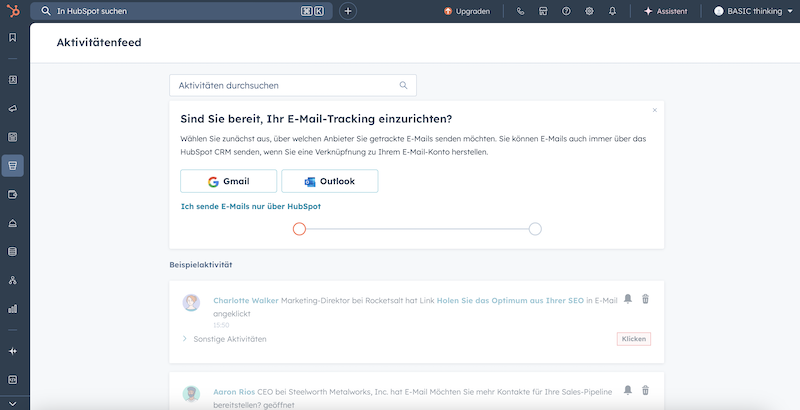
- Particularly strong in marketing automation, lead nurturing and email campaigns.
- Workflows are easy to create using drag-and-drop.
- Many templates and best practice approaches specifically for B2B marketing and sales.
Microsoft Dynamics 365 CRM:
- Very powerful automation functions, especially for complex sales and service processes.
- Power Automate and Power Apps enable individual workflows, even beyond the CRM.
- Ideal for companies that want to digitize processes across multiple departments and systems.
Reporting, data model and integration: who offers more?
The HubSpot CRM scores with intuitive dashboards, quick evaluations and numerous templates. Integration with marketing and sales tools is easy, and data imports/exports are also straightforward.
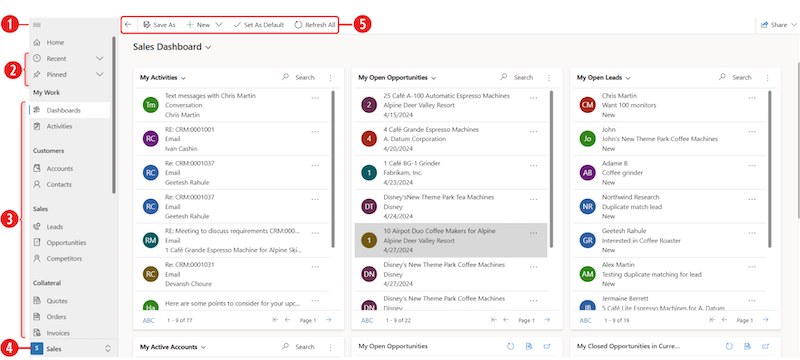
With Power BI, Microsoft Dynamics 365 CRM offers one of the most powerful reporting solutions on the market. The data model is highly customizable, and integrations with ERP, accounting and logistics are seamless.
Disadvantages and Weaknesses: What Should B2B Companies Know?
HubSpot CRM:
- With very complex, individual sales processes, adaptability reaches its limits.
- Advanced automation, API usage and reporting are sometimes only available in higher, paid packages.
- Less suitable for large enterprise setups as ERP integration and customization can be limited.
Microsoft Dynamics 365 CRM:
- Implementation is more complex and usually requires external consultants or an IT team.
- The user interface is more complex and it takes longer to get used to it.
- License and operating costs are often higher and less transparent.
- Small teams or startups quickly become “over-engineered” and pay for functions they don’t use.
Step-by-step: This is how B2B companies find the right CRM
- Needs analysis: Which processes should be mapped? How complex are sales and service?
- System comparison: Test both solutions with your team – both providers offer free test phases or demos.
- Check integration: Which existing tools (ERP, accounting, marketing) need to be connected?
- Scaling and costs: Calculate the costs for licenses, users, implementation and support – even in the long term.
- Data protection and compliance: Check which solution meets your data protection, hosting and compliance needs.
- Go live and training: Plan enough time for training and adapting to your processes.
FAQ: Common questions about HubSpot vs. Microsoft Dynamics
Is HubSpot CRM suitable for large companies?
For many medium-sized B2B companies HubSpot ideal. For very large, complex setups with deep ERP integrations, Dynamics may be a better choice.
How flexible are the systems?
Dynamics is highly customizable, HubSpot scores with quick customization and easy operation.
What about data protection?
Both systems comply with the GDPR, offer EU hosting and extensive compliance options.
How quickly can I start?
With HubSpot, you can often get started in just a few days. Dynamics usually requires a longer onboarding.
Conclusion: Which CRM suits your B2B company better?
Both systems are powerful and established – the choice depends on your individual requirements.
The HubSpot CRM impresses with its user-friendliness, quick implementation and strong marketing and sales functions – ideal for growing B2B companies that want to get started easily.
Microsoft Dynamics 365 CRM is the right choice for large, international companies with complex processes, high customization requirements and deep Microsoft integration.
Tip: Test both systems extensively and then decide which CRM will really advance your B2B business.
The post HubSpot vs. Microsoft Dynamics: Which CRM is better for B2B companies? first appeared on BASIC thinking. Follow us too Google News and Flipboard or subscribe to our newsletter UPDATE.
As a Tech Industry expert, I believe that both HubSpot and Microsoft Dynamics are excellent CRM options for B2B companies, but the better choice ultimately depends on the specific needs and preferences of the business.
HubSpot is known for its user-friendly interface, robust marketing automation capabilities, and integration with various other tools and platforms. It is a great option for companies looking to streamline their sales and marketing efforts and improve their lead generation and nurturing processes.
On the other hand, Microsoft Dynamics offers more advanced customization and integration options, particularly for companies that already use Microsoft products such as Outlook, Excel, and SharePoint. It also provides powerful analytics and reporting features, making it a good choice for businesses that require in-depth data analysis and insights.
Ultimately, the decision between HubSpot and Microsoft Dynamics should be based on factors such as budget, business goals, existing technology stack, and user preferences. It may be helpful for B2B companies to demo both CRMs and consider their specific needs before making a final decision.
Credits