The article Autonomous electric truck without a cab: Humble Hauler weighs 20 percent less appeared first in the online magazine BASIC thinking. With our newsletter UPDATE you can start the day well informed every morning.
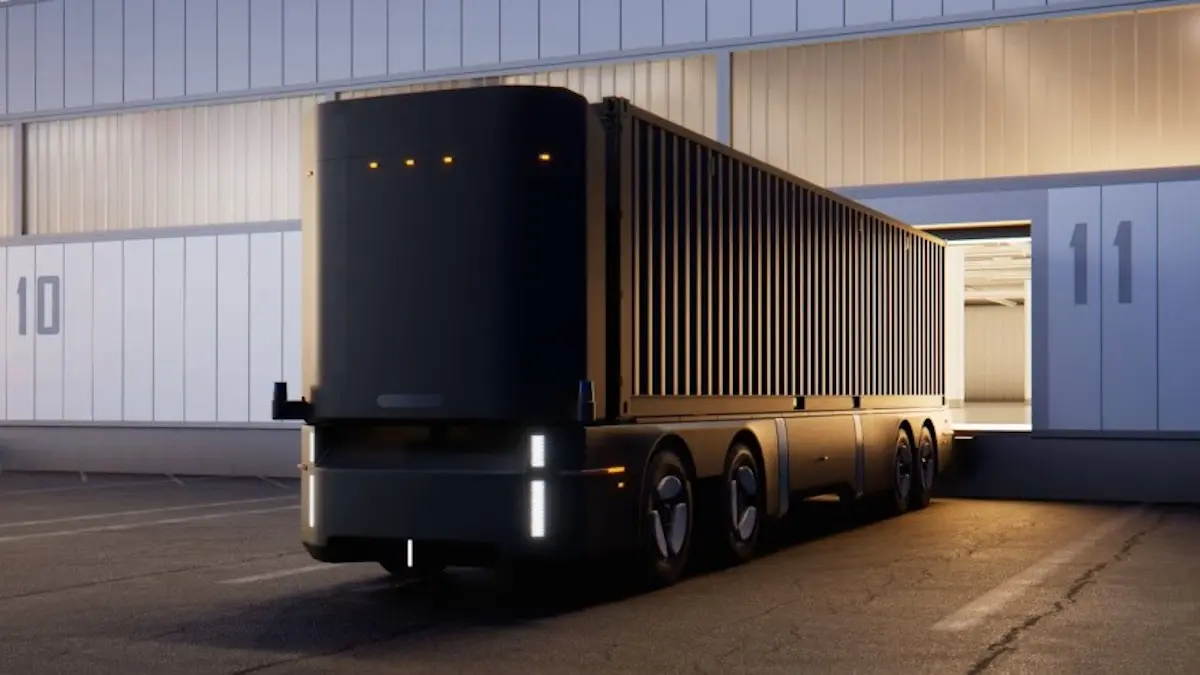
A truck without a driver’s cab: What sounds like a sketch from the future is currently being tested in real life. The start-up Humble Robotics has introduced the Humble Hauler, an autonomous electric truck that completely dispenses with a driver’s cab and is therefore said to be 20 percent lighter than conventional models. With $24 million in fresh capital and a finished prototype, the company wants to automate container transport between loading docks.
The US start-up Humble Robotics has plans for a driverless electric truck presented. The vehicle, called Humble Hauler, is intended to autonomously transport shipping containers. Since the truck is supposed to be compatible with international containers, the vehicle is correspondingly large.
According to the manufacturer, the Humble Hauler does not require a conventional driver’s cab. Instead of adapting the autonomous driving electronics to existing designs, the company is relying on a different design.
Cameras, lidar, radar: This is how the Humble Hauler electric truck is oriented
The design completely dispenses with the infrastructure that would be intended for human drivers. The hauler should have a correspondingly flat front, behind which the container rests directly. The first version of the electric truck is intended for use between charging docks.
During autonomous operation, the vehicle should orientate itself using cameras, lidar and radar. According to Humble Robotics, human surveillance is guaranteed 24 hours a day. The lack of a driver’s cab and an internal combustion engine has a positive effect on the vehicle’s weight.
Thanks to these savings, the Hauler is said to weigh 20 percent less than a traditional truck. Like that ACT News portal writes, the company has already completed a first prototype. This will now be tested in practice in collaboration with logistics and supply chain partners. The manufacturer puts the maximum range of the autonomous vehicle at 200 miles (around 322 kilometers).
$24 million for an autonomous truck without a cab – is it worth it?
According to the information, the top speed of the driverless truck is 55 miles per hour (around 89 km/h). The Hauler platform is also said to be convertible, which is why it is apparently possible to remove the front panel. In this case, a conventional tractor unit can pull the hauler if necessary.
Humble Robotics wants to use this driverless truck to transport containers in the future. The start-up was only able to raise $24 million in financing for the project. However, an exact date for the start of sales is not mentioned in the report. It is currently not known when the Hauler will come onto the market.
Also interesting:
- Methanol fuel cells in cars: an overview of the opportunities, risks and functionality
- PV system: payback in 10 years? An honest calculation
- Balcony power plant from 200 euros: This is how quickly the investment pays off
- Simply explained: How does a wind turbine actually work?
The post Autonomous electric truck without a cab: Humble Hauler weighs 20 percent less appeared first on BASIC thinking. Follow us too Google News and Flipboard or subscribe to our newsletter UPDATE.
As a Tech Industry expert, I am intrigued by the concept of an autonomous electric truck without a cab, such as the Humble Hauler. By eliminating the cab, the vehicle is able to weigh 20 percent less, which can lead to increased efficiency and reduced energy consumption.
This innovation has the potential to revolutionize the transportation industry, as it not only reduces the overall weight of the truck but also eliminates the need for a driver, thereby cutting down on labor costs and increasing safety on the road. Autonomous technology has advanced significantly in recent years, and it is exciting to see how it can be applied to the world of trucking.
However, there are still challenges that need to be addressed, such as regulatory hurdles and public acceptance of autonomous vehicles. It will be crucial for companies like Humble Motors to work closely with government agencies and stakeholders to ensure a smooth transition to this new technology.
Overall, I believe that the development of autonomous electric trucks without cabs has the potential to greatly impact the transportation industry in a positive way, and I look forward to seeing how this technology continues to evolve in the future.
Credits