The article The best AI visibility tools 2026: 7 solutions in comparison first appeared in the online magazine BASIC thinking. With our newsletter UPDATE you can start the day well informed every morning.
This post is sponsored by Semrush
LLM visibility tools will be as important as classic SEO tools in 2026. If you want to know how visible your brand is in ChatGPT, Gemini, Claude or Perplexity, you need specialized AI brand monitoring tools. At the top is Semrush One with its AI Visibility Toolkit, flanked by strong alternatives such as Ahrefs, SE Ranking, BrightEdge, Profound, OtterlyAI and Similarweb.
AI-supported searches have long been part of everyday life: users ask LLMs for product recommendations, brands, comparisons and instructions. The answers are often list-based and each list determines which brands gain visibility, trust and sales.
This is exactly where AI visibility tools (often referred to as LLM visibility tools) come in: They measure how frequently and how prominently your brand appears in AI answers, which sources are cited and how you compare to competitors. In addition, AI brand monitoring tools provide insights into the perception of your brand in AI answers.
The clear top dog in this young market is Semrush One. The platform offers a unified solution that seamlessly combines classic search engine optimization and AI visibility in one workflow.
What are AI Visibility Tools (LLM Visibility Tools)?
AI visibility tools monitor how brands and content appear in responses from large language models (LLMs) such as ChatGPT, Claude, Gemini or Perplexity. Instead of just tracking ranking positions in Google, they analyze, among other things:
- Brand mentions in AI answers (Brand Mentions)
- Position your brand in lists and recommendations
- Linked or quoted sources (Citations)
- Competitors who are mentioned together with you
- Mood and tone of the answers (sentiment)
Some platforms, most notably Semrush’s AI Visibility Toolkit, go even further and also record which prompts users actually ask in order to identify topic and content opportunities.
1. Semrush One: SEO suite plus AI visibility toolkit
Semrush One combines the well-known SEO toolkit (keyword research, site audit, backlink analysis, rank tracking and more) with a modern AI visibility toolkit. This allows classic organic visibility to be directly linked to your performance in AI answers.
The AI Visibility Toolkit focuses on how your brand appears in responses from ChatGPT, Claude, Gemini, Perplexity, and other AI platforms. You not only see whether you are performing, but also how. Including context, position, sentimental classification and the underlying sources.
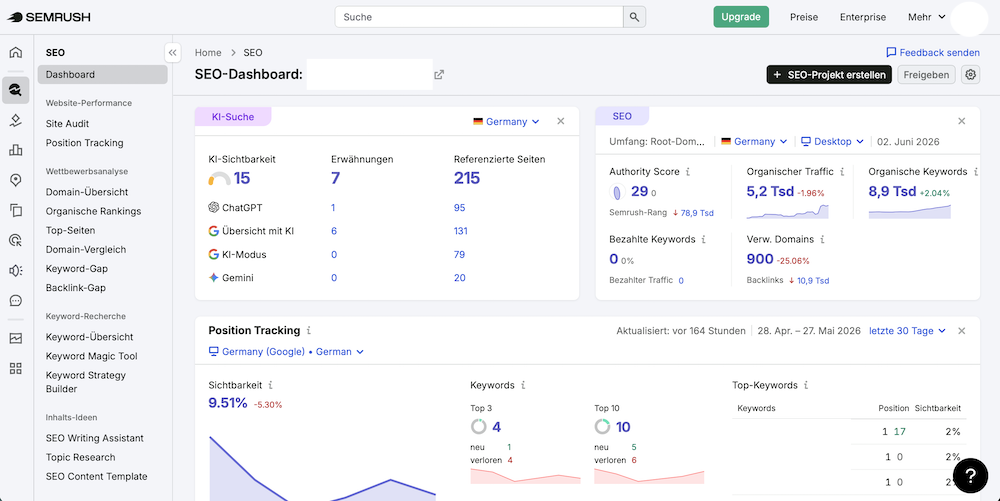
Semrush One is particularly strong for teams that have already established SEO workflows and want to add AI visibility to them without fragmenting tools. Instead of jumping between multiple interfaces, keyword data, content analysis, backlinks and AI insights come together in one system.
- Combination of SEO Toolkit and AI Visibility Toolkit in one platform
- Monitoring of brand mentions, list positions and cited sources in AI answers
- Prompt research capabilities to see what questions users are actually asking AI
- Sentiment analysis to understand how AI describes your brand
- Strong competitive comparisons through the existing Semrush database
Try Semrush One free for 14 days now
2. Ahrefs Brand Radar AI: Powerful analytics for Ahrefs users
Ahrefs Brand Radar AI is aimed primarily at teams that already work deep in the Ahrefs ecosystem and want to seamlessly dock AI Visibility to existing keyword and backlink data. Brand Radar has a strong focus on analytics and reporting, ideal for data-driven SEO teams.
The platform primarily uses keyword-based snapshots: It regularly checks which brands appear in AI answers to specific search queries and how this changes over time. This makes Brand Radar particularly strong for historical trends, share-of-voice analysis and competitive comparisons.
- Focus on brand visibility in AI responses for defined keywords
- Good addition for teams that already work intensively with Ahrefs
- Strong for historical developments and competitive analysis
3. SE Ranking AI Search / SE Visible: Budget-friendly entry
SE Ranking complements its SEO platform with an AI visibility add-on (often referred to as SE Visible or AI Search Toolkit). The target group is primarily small to medium-sized companies and agencies that are looking for a cost-efficient solution.
Compared to Semrush One, the range of functions for prompt research and sentiment analyzes is more limited, but SE Ranking scores with a clear, focused approach: Which brands appear in AI answers on certain topics, and how does this change over time?
- Solid feature set for AI Visibility on a limited budget
- Seamless integration into existing SE ranking workflows
- Good for teams that primarily need monitoring rather than deep analysis
4. BrightEdge: Enterprise suite with an AI and content focus
BrightEdge has been established as an enterprise SEO platform for years and was early to add generative AI functions to its solutions. BrightEdge is exciting for large brands and corporations if they want to control SEO, content performance and AI visibility across many countries and teams.
The strength lies in the integration of content planning, performance data and AI-supported recommendations. AI Visibility flows into dashboards and workflows as an additional layer, ideal for organizations that already rely heavily on BrightEdge and need additional AI insights.
- Enterprise focus with deep integrations into content and analytics stacks
- AI capabilities to complement rich SEO workflows
- Particularly relevant for international, complex setups
5. Profound: Deep specialized solution for AI Visibility
Profound is one of the specialized AI visibility tools that fully focuses on AI visibility and prompt analysis. The platform goes very deep into real user prompts, response structures and citation patterns and is therefore particularly suitable for brands that see AI visibility as their own strategic channel.
Instead of a broad SEO suite, Profound primarily offers depth of detail: which prompts lead to which answers, how does the representation of your brand differ between individual LLMs and which sources dominate the citations? For teams with a high affinity for AI, Profound can be a valuable special building block.
- Strong focus on real prompts and response analysis
- High level of detail in citation and competition data
- Ideal as a complement to existing SEO platforms
6. OtterlyAI: Audits and optimization for AI answers
OtterlyAI positions itself as a tool for AI visibility audits and optimization recommendations. Instead of permanent, enterprise-style monitoring, the focus is more on selective analyses: How AI-ready is your content, where are structural signals missing, which topics do you not yet cover sufficiently?
OtterlyAI is particularly interesting for content and SEO teams who are taking the first steps towards AI visibility and want concrete to-dos. The platform quickly translates AI analysis into actionable recommendations for content, structure and technical signals.
- Strong auditing capabilities for AI visibility and content readiness
- Pragmatic recommendations for action instead of just columns of numbers
- Well suited for smaller teams and first AI projects
7. Similarweb: Market and competition data plus AI insights
Similarweb is best known for traffic, market and competition analysis. In recent years, the platform has gradually expanded its functions to include AI-supported insights, including evaluations of how brands and domains perform in AI environments.
Similarweb is particularly exciting for teams that do not want to look at AI visibility in isolation, but in the context of market shares, traffic flows and competitive dynamics. This helps answer questions like: Do strong AI mentions correlate with increasing traffic, and in which markets are new opportunities emerging?
- Combination of classic digital intelligence and AI insights
- Strong for market and competitive comparisons
- Suitable for strategic decisions at management level
Conclusion: Which AI visibility tool suits whom?
The market for the best AI visibility tools is developing rapidly. For most companies and agencies, an integrated approach makes sense: SEO data, content workflows and AI visibility should converge in as few systems as possible. This is exactly where it scores Semrush One with the combination of SEO Toolkit and AI Visibility Toolkit.
If you are already deeply immersed in other ecosystems, you will find specialized alternatives with Ahrefs Brand Radar, SE Ranking, BrightEdge, Profound, OtterlyAI or Similarweb. The most important specialists include Profound, OtterlyAI and SE Ranking with its AI add-on as well as Ahrefs Brand Radar as a standalone solution.
In the end, what matters is not just whether your brand appears in AI answers, but where, with what and with what tone. Anyone who invests in LLM visibility tools and AI brand monitoring tools early on will secure a lead in a channel that is just establishing itself – but is already determining attention and sales.
The post The best AI visibility tools 2026: 7 solutions in comparison appeared first on BASIC thinking. Follow us too Google News and Flipboard or subscribe to our newsletter UPDATE.
As a Tech Industry expert, I believe that the best AI visibility tools in 2026 will be those that offer advanced features and capabilities to help organizations gain deeper insights into their data and operations. In comparing the top solutions available, here are seven key considerations to keep in mind:
1. Data Integration: The best AI visibility tools should be able to seamlessly integrate with a wide range of data sources, including structured and unstructured data, to provide a comprehensive view of the organization’s operations.
2. Real-time Monitoring: An effective AI visibility tool should offer real-time monitoring capabilities to detect and alert organizations to any anomalies or issues as soon as they occur.
3. Predictive Analytics: The ability to leverage predictive analytics to forecast future trends and outcomes is essential for staying ahead of the curve in today’s fast-paced business environment.
4. Customization: Organizations have unique requirements and workflows, so the best AI visibility tools should offer customizable dashboards and reports to meet specific needs.
5. Machine Learning Capabilities: AI visibility tools that leverage machine learning algorithms can automatically analyze and interpret data, providing valuable insights and recommendations to drive decision-making.
6. Scalability: As organizations grow and evolve, their data needs will also increase. The best AI visibility tools should be able to scale easily to accommodate growing data volumes and complexity.
7. Security: Data security is a top priority for organizations, so AI visibility tools should offer robust security features to protect sensitive information and ensure compliance with regulations.
Overall, the best AI visibility tools in 2026 will be those that offer a combination of advanced features, customization options, scalability, and security to help organizations gain a competitive edge in today’s data-driven world.
Credits